

Treatments for Skin Tightening: A Practical Guide

You notice it in ordinary moments, not in dramatic ones. A side profile in a shop window, a selfie from below, or the way your jawline looks a little softer when you've had a long week can make skin laxity feel suddenly obvious. That change usually isn't sudden at all, it's the visible result of collagen and elastin thinning, support structures changing beneath the skin, and daily wear from sun, movement, and time.
That's why the smartest treatments for skin tightening start with an honest read on what's changing. Some approaches can nudge mild to moderate laxity into a firmer place, especially when the problem is loose texture rather than extra skin. Others are better at camouflage, volume support, or true lifting, and a few don't belong in the conversation at all when the issue is advanced sagging.
Why Skin Loses Its Snap in the First Place
The person who notices loosening first is often looking at the lower face, neck, or eyelids and thinking, “That used to look sharper.” That reaction makes sense because those areas show change early. The skin is thinner there, it moves constantly, and it has less forgiveness when collagen starts to decline.
What changes under the surface
Collagen and elastin are the structural proteins that help skin spring back after movement. Over time, natural repair slows, repeated UV exposure adds damage, smoking and sugar-driven glycation make the problem worse, and hormonal shifts around perimenopause can accelerate visible softening. Facial bone and fat support also change gradually, so laxity is rarely just a skin issue, it's usually a layered one.
Practical rule: if the concern is loose texture and early droop, tightening may help. If the concern is excess skin or major tissue descent, tightening alone won't solve it.
That's why expectations matter. Skin tightening can improve mild to moderate laxity by encouraging more collagen, but it can't remove extra skin or rebuild lost bone support. A treatment plan should match the anatomy in front of you, not the marketing on a device page. For a useful primer on why the lower face starts to change, see what causes jowls.
Where laxity shows first
The first telltale zones are usually the jawline, neck, eyelids, and upper arms. Those areas show looseness because they're thin, mobile, and often exposed to the sun. The same biological process can show up differently depending on genetics, weight history, and skin type.
A careful clinician looks for whether the tissue still has recoil. If it does, non-surgical treatments may be useful. If it doesn't, the discussion should shift toward camouflage, combination care, or surgery rather than pretending a device can do more than it can.
How Energy-Based Skin Tightening Actually Works
Most non-surgical tightening devices rely on the same biology. They create controlled thermal or mechanical stress in the skin, which triggers a wound-healing response, and that response brings fibroblasts into action to lay down new collagen. Over weeks and months, the tissue remodels, contracts, and looks firmer.
The depth matters
Different devices target different layers. Some work more superficially in the epidermis, some heat the deep dermis, and some are designed to reach the fibro-muscular layer beneath the skin. That difference matters because the problem you're treating isn't always at the same depth. A surface-texture issue needs a different tool from a jawline that needs deeper support.
Fractionated approaches leave small untreated zones between points of energy. That spacing helps recovery because surrounding tissue can support healing. Bulk-heating systems, including older radiofrequency platforms, warm a broader area more evenly. Both can work, but they aren't interchangeable.
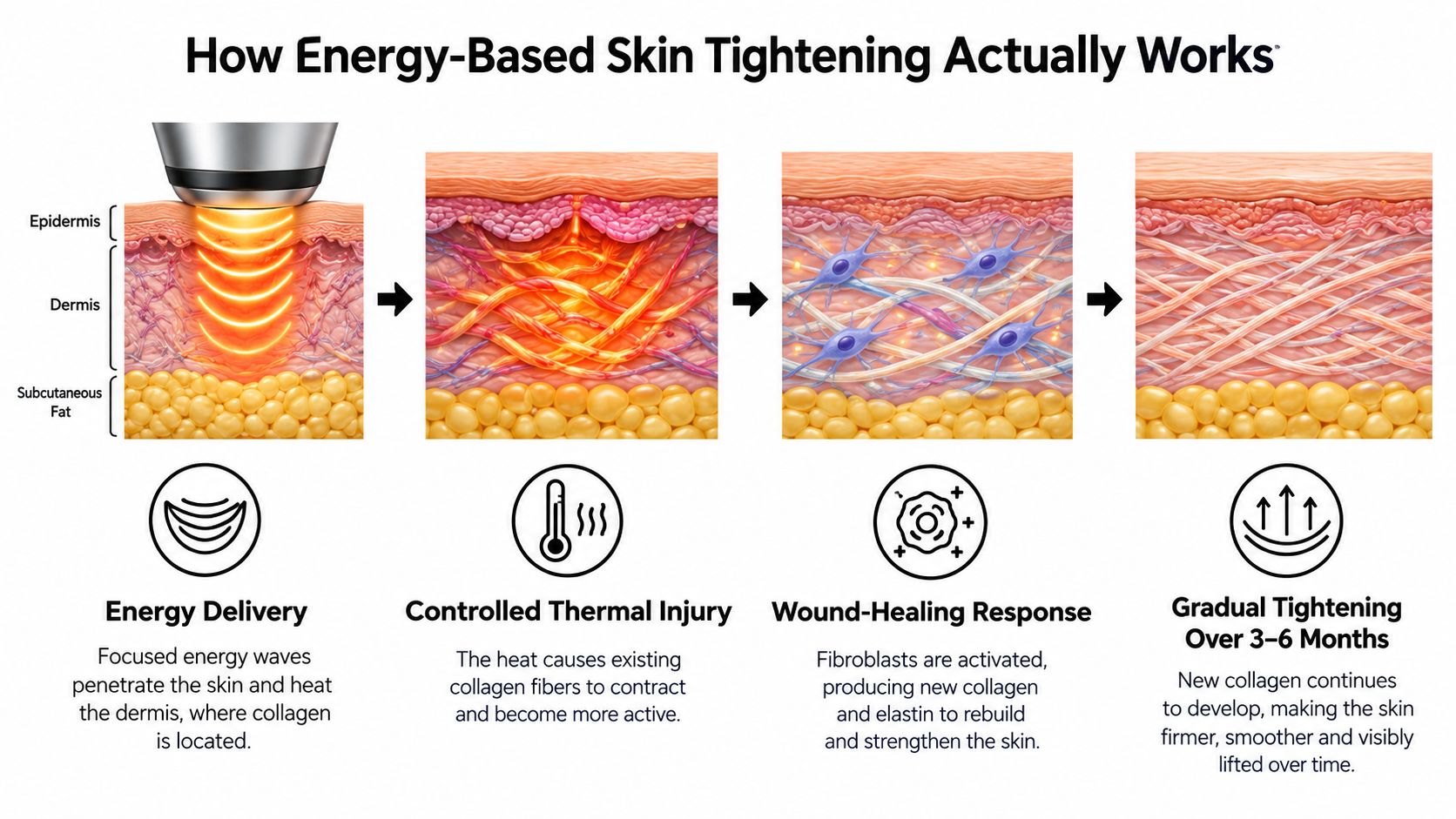
Clinical reality: visible tightening isn't instant. Most meaningful change builds as collagen remodels over time, not at the moment the device is turned off.
What the timeline looks like
The early effect may be a small contraction from heat. The more important change is slower, as new collagen matures and tissue architecture becomes denser. In practice, that means patience matters. A good device, used with appropriate settings and good technique, can produce gradual tightening, but it won't behave like a facelift.
Energy settings, pulse duration, and cooling all influence comfort and safety. The right parameters depend on the device, the treatment depth, and the skin in front of you. That's why “more energy” is not a strategy, it's just a risk if the wrong layer gets overheated.
For a deeper comparison of device logic, see XERF vs Thermage vs Ultherapy.
Comparing Lasers, RF, Ultrasound, and Microneedling
Patients often ask for “the tightener,” as if every platform does the same job. It doesn't. The better question is which energy source matches the problem, the skin type, and the amount of recovery someone can tolerate.
What each modality actually does
Modality | Energy Source | Target Depth | Typical Downtime | Best For |
|---|---|---|---|---|
Traditional RF | Radiofrequency heat | Dermis | Minimal | Mild jowl and cheek laxity |
Ultrasound | Focused sound energy | Deep dermis and deeper support layers | Minimal | Brow, lower face, and deeper lifting goals |
Fractional laser | Light energy | Superficial to mid-dermis | Variable | Texture, fine lines, and mild tightening |
RF microneedling | Needles plus RF heat | Dermis at a programmed depth | Usually brief | Thicker skin, acne scarring, and firmness |
IPL | Broad light spectrum | Surface vascular and pigment concerns | Usually limited | Redness and pigmentation, not primary tightening |
Traditional radiofrequency is often chosen when the concern is mild looseness around the jawline or cheeks. It's relatively versatile and usually has little downtime, which makes it practical for people who want improvement without disappearing for days. Ultrasound reaches deeper, so it's better suited to lifting-style goals in selected candidates, especially when the lower face or brow is the priority.
Skin type and candidacy
Lasers can improve both texture and firmness, but they're not equally forgiving across all phototypes. Darker skin tones are often better served by RF-based approaches or RF microneedling than by many laser platforms, because the pigment risk profile is different. RF microneedling is also useful when the skin is thicker or acne-scarred, since it can address texture and firmness together.
For a London, Ontario lens on how microneedling fits into broader planning, microneedling in London, Ontario is a helpful point of reference.
Why IPL sits beside, not on top of, the list
IPL belongs in the conversation because it can refine redness and uneven pigment, which often makes skin look older than it is. It's a complement, not a primary tightening tool. When the issue is laxity, light-based colour correction may improve skin quality, but it won't replace structural tightening.
Fillers, Threads, and the Surgical Option
Once skin is loose enough that energy devices can't do the whole job, the conversation shifts. At that point, the right question is not “What's the strongest non-surgical treatment?” but “What amount of lift do I really need?”
Where fillers fit
Hyaluronic acid fillers and biostimulators such as Sculptra or hyperdilute Radiesse don't tighten skin in the same way a device might. They restore structure, soften shadows, and sometimes make the face read as firmer because support is back where it belongs. That's useful when the problem is deflation plus mild descent.
They're not a substitute for removing extra skin. If the lower face has started to drape heavily, filler can blur the issue, but it can also make the face look heavier if overused.
What threads can and can't do
PDO threads offer temporary repositioning, which sounds more dramatic than it usually is. They can create a subtle lift and then contribute to collagen formation over a short window, but they're not a facelift substitute. They work best for carefully selected candidates with moderate laxity, not for someone expecting a surgical result without surgery.
Threads can buy time, not replace anatomy.
When surgery is the cleaner answer
A lower face and neck lift, brow lift, or blepharoplasty becomes the honest option when the signs are more advanced, like significant jowling, platysmal banding, or excess skin that no device can remove. Surgery also has the strongest longevity advantage, often measured in years rather than months, but it comes with anesthesia, incisions, visible healing time, and a longer recovery window.
The practical framing is simple. Mild laxity often suits fillers or energy devices. Moderate laxity may suit threads or combination care. Advanced laxity usually needs surgery if the client wants a true structural change.
Safety, Risks, and Common Misconceptions
Good outcomes depend on choosing the right tool and using it correctly. The risks are different by modality, but every serious treatment has them, and clients should ask about them before they book.
Real risks by platform
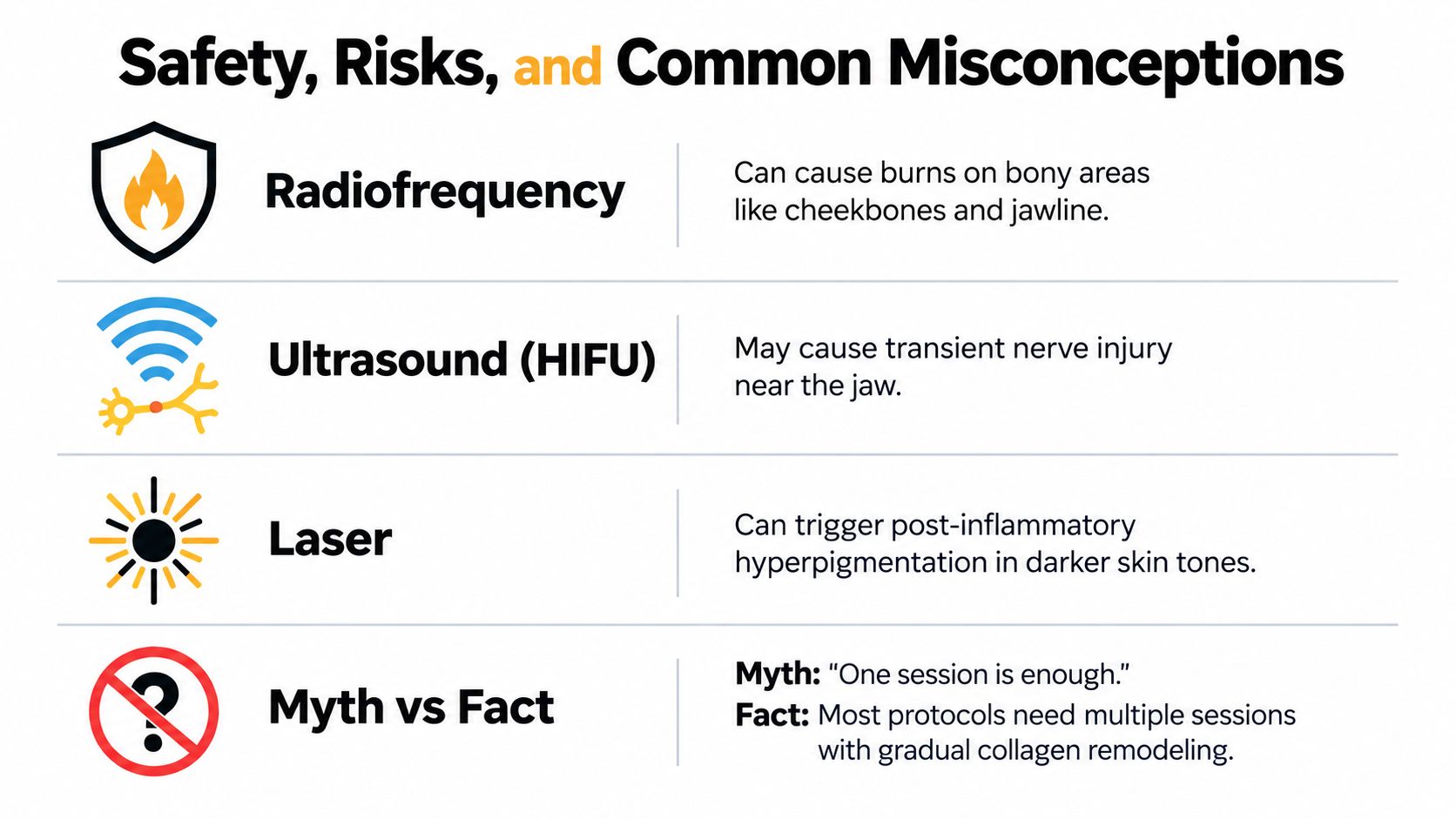
RF can burn bony areas like the cheekbones or jawline if energy is concentrated poorly. Ultrasound can irritate nerves near the jaw, which is usually temporary but still worth discussing. Lasers can trigger post-inflammatory hyperpigmentation in melanin-rich skin if settings or aftercare are off. Threads can migrate or create puckering. Fillers carry the rare but serious risk of vascular occlusion.
Health Canada has also highlighted complications and potential complications related to RF microneedling devices, including burns, scarring, unintended fat loss, disfigurement, and nerve damage, and it classifies licensed RF microneedling devices as Class III medical devices. That matters because a device licence, clearance, or approval tells you the platform has been reviewed for its intended use, but it doesn't replace operator skill or good consent.
Misconceptions worth dropping
Skin tightening is not fat reduction. It's also not a one-and-done treatment in most cases, and it doesn't usually look finished right away. The improvement builds as collagen remodels over time, which is why a single session often isn't the whole plan. At-home RF tools can be useful for maintenance, but they don't deliver the same clinical control or depth as professional devices.
A quick clinic self-screen
Ask for the device name: If a clinic can't name the platform clearly, that's a problem.
Check for informed consent: Burns, pigment change, scarring, or swelling should be discussed before treatment.
Look for a patch test when indicated: This matters more in sensitive or darker skin types.
Request photos of similar clients: You want realistic examples, not only ideal outcomes.
Confirm who is treating you: Training and experience matter more than polished marketing.
If a consultation feels rushed, vague, or dismissive, walk away. A good provider explains trade-offs plainly and gives you room to decide.
Skin Tightening Options at Skinsation Aesthetics in London
Skinsation Aesthetics in London, Ontario lists XERF as a skin-tightening option, and that makes it a relevant local starting point for people with mild to moderate laxity. XERF is described by the clinic as a dual-frequency monopolar radiofrequency treatment meant to lift and tighten skin without needles, numbing, or downtime, and the clinic says sessions are designed to be quick and comfortable, with continued improvement over the following weeks. The listed service page also places it in the face, neck, and body conversation, which fits the way RF is typically used in practice.
How the local consultation should feel
A proper consultation starts with photos, a candidacy review, and a discussion of contraindications. If patch testing is appropriate, it should be offered, not brushed aside. The plan should spell out expected change, the likely number of visits, and what the client can realistically expect if laxity is already advanced.
Skinsation also lists IPL skin tightening as a service, with a starting price of 249 Canadian dollars for a one-hour appointment on its booking page (appointment scheduling for med spas). That price is a starting point, not a fixed total, because treatment needs can vary. IPL makes sense when the goal is cleaner tone and better skin quality alongside a tightening conversation, not when someone is chasing a surgical lift.
Why the price conversation should be transparent
For London clients, price framing should always be honest. A device session is usually a different financial tier from threads or surgery, but the genuine value comes from matching the treatment to the tissue, not from chasing the cheapest option. XERF sits in the non-surgical space where downtime is usually low, which is part of its appeal for people who can't afford a longer recovery.
If the skin is too loose for a device plan, a responsible clinic should say so. That's a strength, not a failure of service. Clients in London who want structured guidance can book with Skinsation Aesthetics and have those limits discussed clearly.
Your Consultation Checklist Before Booking
The best consultation feels specific, not sales-driven. Start with the mirror test. Which area bothers you most, how long has the laxity been visible, and does it look worse at rest, with movement, or both?
The questions to ask in order
Goals and anatomy mapping. Ask which areas are contributing to the problem, and whether the issue is laxity, volume loss, texture, or a mix.
Medical history. Mention pregnancy, autoimmune conditions, active acne or rosacea flares, isotretinoin use within the past 12 months, and any implants or pacemakers.
Device specifics. Ask which energy source is being used, how deep it reaches, how many passes are planned, and whether settings can be adjusted for your Fitzpatrick type.
Downtime and recovery. Ask how many days of social downtime are realistic, when exercise and makeup are safe, and how redness or swelling usually resolves.
Price and follow-up. Request a written quote that covers all sessions, touch-up policies, package terms, and the first review visit.
A consultation should leave you clearer, not more confused.
What to ask for before you book
Ask for before-and-after photos of clients with similar skin type and age. Confirm who performs the treatment and what training they have with that device. If a clinic won't discuss risks, won't show credentials, or won't explain how results are measured, that's a sign to keep looking.
Maintenance matters too. Good providers talk about how results will be reviewed, when to reassess, and whether another modality is a better fit if the first plan doesn't match the anatomy well. For London clients, that kind of structured conversation is exactly what should happen at a Skinsation Aesthetics assessment.
If you're comparing treatments for skin tightening in London, Ontario, Skinsation Aesthetics Inc. offers a practical starting point with XERF and IPL, both discussed in the context of real candidacy and realistic expectations. Visit Skinsation Aesthetics Inc. to review the local options, then book a consultation so your skin, your goals, and your recovery tolerance can guide the plan.
Comments