

Chemical Peel Aftercare: A Day-by-Day Guide

Your skin feels tight, there's a dry patch beside your mouth, and you're wondering whether to moisturize it or leave it alone. After a chemical peel, small changes can raise plenty of questions. Chemical peel aftercare should keep healing skin comfortable, protected and undisturbed, not push it to shed faster.
At Skinsation Aesthetics in London, Ontario, our certified skin care specialist recommends procedures according to each client's skin requirements. Your recovery plan should be just as individual. Use the guide below alongside your treating professional's written directions, especially if you've had a stronger peel.
Your First Week After a Chemical Peel
On the first evening, pinkness and tightness can make your skin feel unfamiliar. Gentle moisturizing and keeping cool should make it more comfortable, not increasingly sore.
First-week recovery timeline
Day | What You May Notice | What to Do |
|---|---|---|
Day 1 | Warmth, tightness and pink or red skin | Cleanse gently, moisturize, keep skin cool and avoid heat |
Days 2 to 3 | Dryness, itching and fine early flakes | Keep moisturizing, don't pick at flakes, keep out of direct sun |
Days 3 to 5 | Visible peeling after a stronger peel; a light peel may barely flake | Let skin shed on its own and use bland products only |
Days 6 to 7 | Calmer, fresher skin with some lingering pinkness | Continue barrier care and hold stronger actives until peeling has stopped |
This is a practical pattern, not a recovery promise. The clinical review in the Australasian Journal of Dermatology describes superficial epidermal regeneration within approximately 3 to 5 days, while deeper peeling may take 10 to 14 days to re-epithelialize.
The first flakes often appear within the first few days, but formulation, depth and skin response affect timing. A light peel may produce very little visible shedding.
Daily check: Compare your skin with the timeline each morning. Note changes that are getting worse rather than gradually settling.
How to Care for Skin in the First 48 Hours
Keep your routine simple. Feeling less sensitive doesn't mean your skin is ready for active ingredients.
Cleanse gently. Use lukewarm water, a fragrance-free cleanser and fingertips only, then pat dry. Brushes and washcloths add unnecessary friction.
Apply the recommended bland moisturizer while skin is slightly damp. This helps reduce moisture loss and tightness.
If skin feels hot, hold a clean, cool cloth against it briefly. Don't apply ice directly, which can injure sensitive skin.
Avoid hot water, steam and heat. A hot shower on the first evening can increase redness and discomfort.
Leave flakes attached. Pulling them away can damage skin that isn't ready to shed.
Repeat gentle cleansing and moisturizing morning and evening, unless your peel-specific plan says otherwise. Consistency is more useful than adding products.
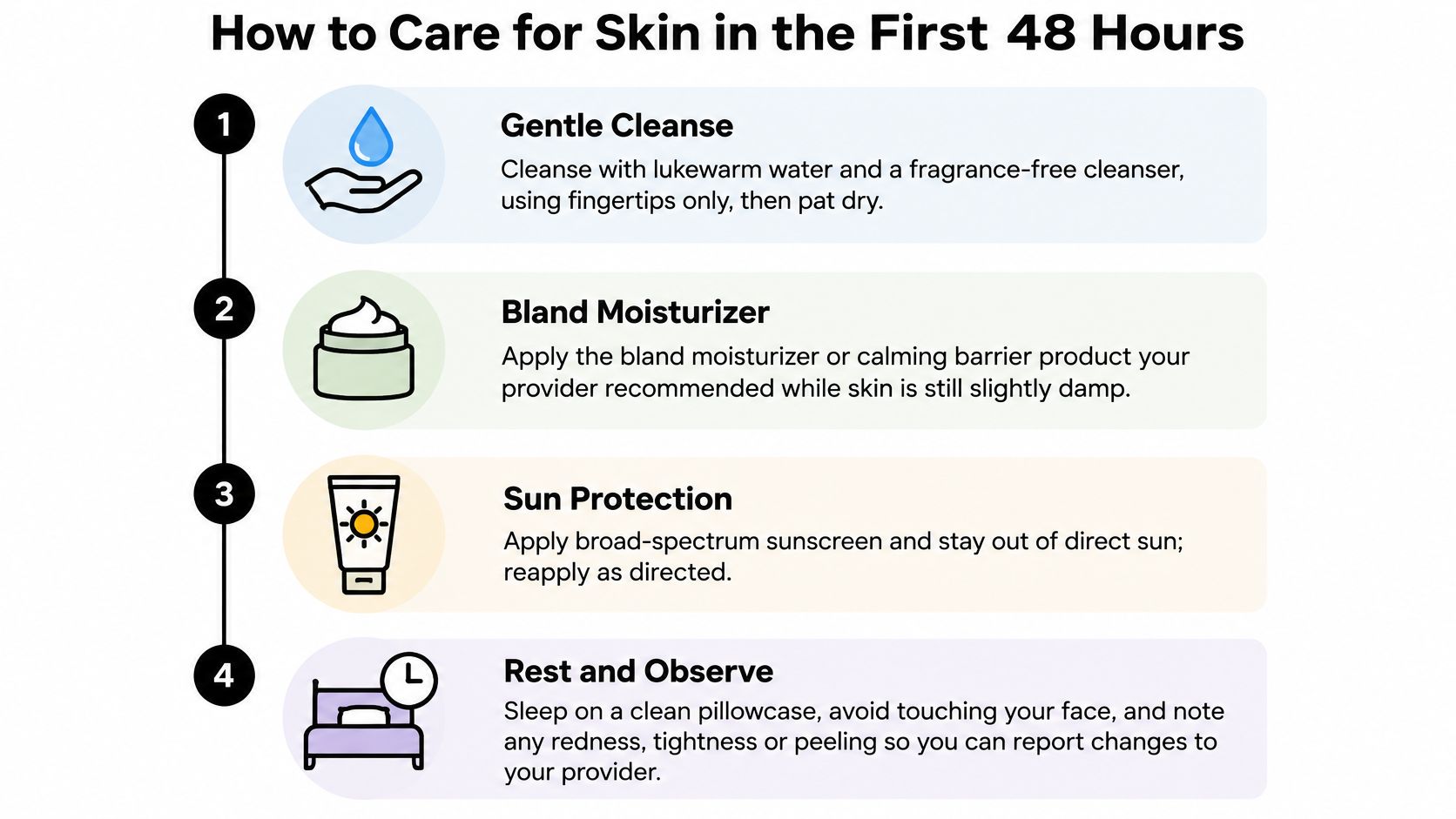
Pacific Derm's Canadian aftercare sheet recommends broad-spectrum SPF 30 or greater for 1 to 2 weeks after treatment. Continue protection beyond that while skin remains sensitive, with shade and a wide-brimmed hat.
If skin is raw or oozing, get application instructions rather than forcing sunscreen onto it. By the end of this early stage, superficial-peel skin may feel tight and patchily dry, but it shouldn't develop spreading heat, blistering or drainage.
Products to Use and Ingredients to Avoid
Post-peel products and what to pause
Product Type | What to Look For | When to Use It |
|---|---|---|
Gentle cleanser | Fragrance-free, mild, suitable for lukewarm rinsing | Morning and night from day 1, as directed |
Bland moisturizer | Fragrance-free, non-comedogenic, short ingredient list | Morning and night, especially during initial recovery |
Calming barrier product | Minimal ingredients, ceramides or an appropriate occlusive | When skin feels tight, as directed |
Broad-spectrum sunscreen | Broad-spectrum, SPF 30 or higher | Daily once application is comfortable and approved |
Retinoids, exfoliating acids, scrubs, benzoyl peroxide | Strong actives or abrasive products | Pause until peeling stops and the clinic clears you, usually at least 5 to 7 days |
That active-product pause isn't a deadline for restarting. Toronto Dermatology Centre's post-peel guidance specifies calming products and avoiding retinol, glycolic acid and salicylic acid for 5 days; stronger treatments may require longer.
Glycolic acid, salicylic acid and retinoids don't help healing skin peel more safely. Premature exfoliation can prolong irritation and contribute to uneven colour. Alberta's provincial chemical-peel guidance also identifies pigment changes, infection and scarring among possible complications.
Our barrier care product guide can help you assess your bathroom shelf. For later everyday use, you can compare aloe gels for daily skincare through AloeCure, but an aloe label doesn't establish that a formula is appropriate immediately after a peel.
Bring your complete product and medication list to your consultation. Don't stop prescribed medication without the prescriber's advice.
Habits to Pause While Your Skin Heals
Pause heat and sweat; resume comfortable movement first. A gentle walk is different from hot yoga or a workout that leaves your face flushed and dripping.
Habit pause windows
Habit | Pause Window | Resume When |
|---|---|---|
Hot tubs, saunas, steam rooms and swimming | About 2 days, longer if directed | Skin feels calm and comfortable |
Heavy sweating and hard workouts | About 2 days | Gentle activity is comfortable before returning to normal training |
Direct sun and excessive heat | 3 to 7 days | Skin has recovered enough for necessary exposure, with sunscreen and a hat |
Laser hair removal, IPL, microdermabrasion and similar services | About 14 days | The clinic confirms recovery |
Tanning booths | At least 3 weeks before or after treatment | Don't resume tanning around a peel |
Makeup | Light peels often allow earlier use | Stronger peels need explicit clearance |
These are conservative planning windows, not permission to resume while your skin remains irritated. For a light peel, makeup is often possible the following day, using clean products and tools over tolerated moisturizer and sunscreen. Stronger peels usually need longer.
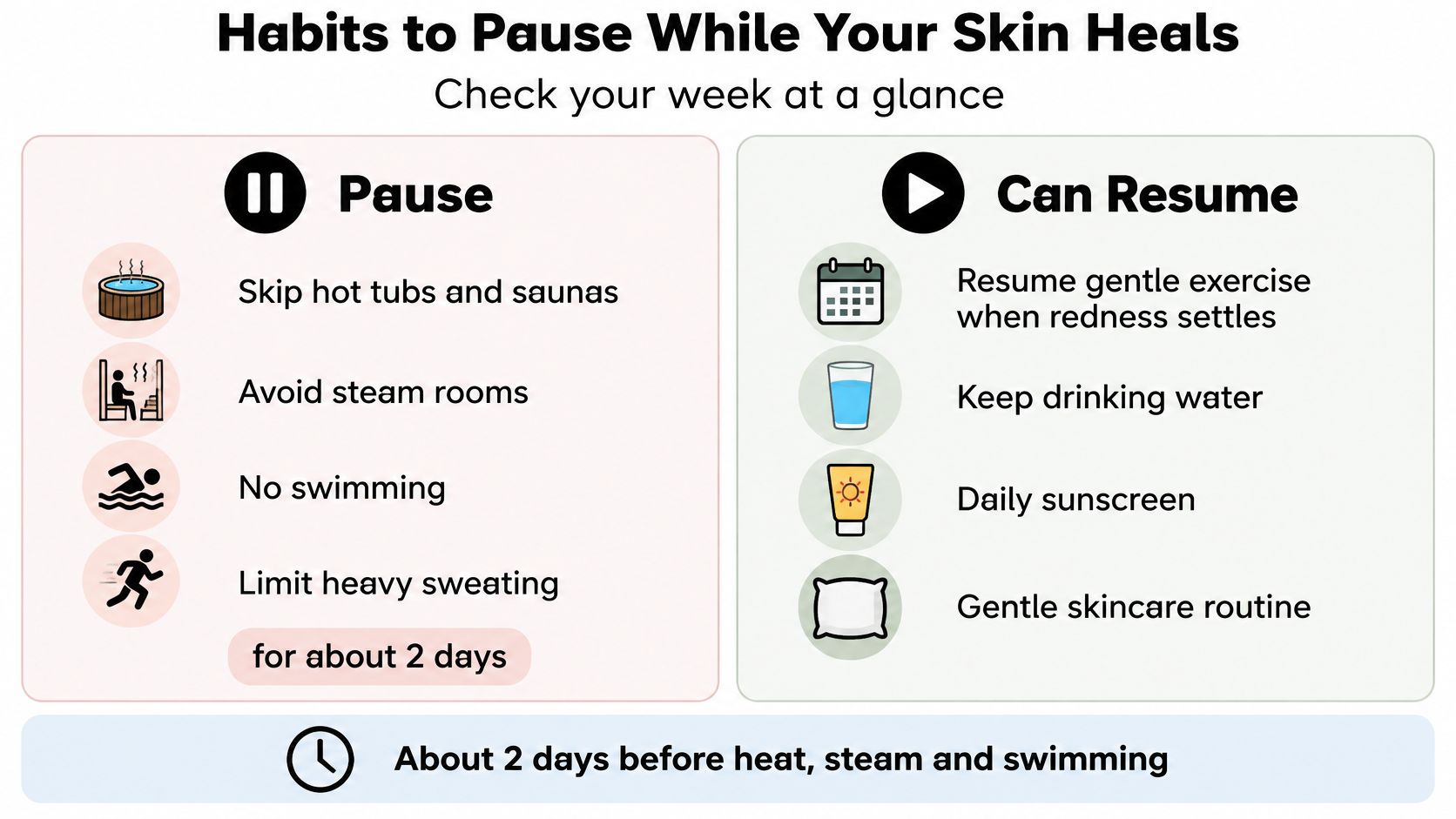
In London, Ontario, cold outdoor air and dry indoor heat can make recovering skin feel tighter. A clean humidifier and a richer, approved barrier moisturizer at night can help with comfort. Keep drinking water normally, and don't skip sunscreen because it's overcast or snowy.
A calendar tells you when to reassess. Your skin tells you whether you're ready.
Our guide to skincare mistakes that keep results from lasting addresses habits worth reviewing before returning to your usual routine.
Normal Reactions and When to Call Our Clinic
Common symptoms and what to do
Symptom | Normal or Call Us | What to Do |
|---|---|---|
Tightness, warmth or mild sting on day 1 | Normal if mild and settling | Cool with a clean cloth and moisturize |
Flaking that follows the peel | Normal | Let it shed without picking |
Little or no visible peeling | Normal for light peels | Continue barrier care; don't force peeling |
Redness lasting more than 2 days | Call us for review | Compare it with your peel-specific recovery plan |
Swelling, especially around the eyes | Call us | Contact the clinic promptly |
Itching or burning that worsens | Call us | Don't scratch; contact the clinic |
Blistering or crusting | Call us | Contact the clinic the same day |
Pus, oozing, fever or spreading redness | Urgent | Seek medical care now and notify the clinic |
Unusual darkening or lightening | Call us | Avoid sun and don't self-treat |
The redness review point is a cautious contact rule, not proof of a complication. Stronger peels can stay red longer. The American Academy of Dermatology's chemical-peel guidance advises contacting a dermatologist about burning, itching or swelling and warns that scratching can cause infection.
More peeling doesn't mean a better result. Fine, nearly invisible shedding can occur after a light peel. Medium-to-deep skin tones also warrant early attention to new dark patches because irritation can trigger post-inflammatory hyperpigmentation.
Tell us before treatment about cold sores, isotretinoin and recent medications. During recovery, take a clear morning photo in consistent light so changes are easier to assess.
For general hygiene principles, Evo Dyne Products explains how to keep cuts from infecting. That isn't a post-peel treatment protocol, and suspected infection needs medical assessment, not home experimentation.
Book Your Next Peel Once Your Skin Has Recovered
Fresh-looking skin does not confirm readiness for another peel. Superficial peels generally settle sooner than deeper procedures, but rebooking belongs after active peeling and irritation have fully resolved and your skin has been assessed.
Our certified skin care specialist recommends the procedure suited to your skin's requirements. The Acne Peel uses salicylic acid, AHAs, oxygen and benzoyl peroxide on non-inflammatory and inflammatory lesions. The Zena line includes the Zena Algae Peel and the Zena Natural Pro-Retinol Peel, which carries its own retinoid-related directions. If your last session produced minimal flaking, that alone is no reason to rebook sooner.
Review our Zena peel options, the Zena peel results and broader chemical peel examples to set realistic expectations. Someone else's recovery is not your booking timetable. Once you know what your skin needs, our chemical peel cost guide can help with budgeting.
To book a chemical peel consultation in London, Ontario, use the Book Now button on our Chemical Peels service page. Microneedling services can be booked the same way.
Chemical Peel Aftercare Questions Answered
When will my skin start peeling?
Early flakes commonly appear within the first few days. Formula, depth and individual response affect the pattern, so use the timeline as a guide rather than expecting a particular amount of shedding.
Can I wear makeup after a chemical peel?
A light peel may allow makeup once the skin is comfortable and your treating professional approves. Don't cover raw, cracked or weeping areas, and use clean applicators without rubbing.
Can I exercise after a peel?
Choose a comfortable walk before strenuous training. Delay hard or heated workouts until sweating and warmth won't aggravate your recovering skin.
What if my skin doesn't peel?
Don't add a scrub or acid to make something happen. Continue the prescribed care and judge recovery by comfort, colour and healing, not the quantity of flakes.
The safer choice: If you're unsure whether a reaction is normal, contact the clinic before trying another product.
Skinsation Aesthetics Inc. offers chemical peels with individualized treatment recommendations and practical guidance for caring for recovering skin. Book a consultation in London, Ontario by calling 519-933-8538, or visit Skinsation Aesthetics Inc. to plan your treatment and aftercare.
Comments