

What Causes Jowls: The Science Behind Jawline Changes

You notice it first in a photo you weren't expecting, a side angle under bright bathroom lights, or a familiar mirror that suddenly looks less familiar. The jawline that used to sit cleanly against the neck now looks softer, and the change can feel bigger than the mirror itself. That reaction is common, because jowls are one of those facial changes people see before they can explain.
What catches many people off guard is that this isn't just “loose skin.” In most faces, the lower face is changing in layers, with volume loss, fat descent, ligament laxity, and weakening support beneath the skin all contributing at once. That's why two people can be the same age and have very different jawlines, and why the answer to what causes jowls is never a single simple cause.
Recognizing When Your Jawline Starts Changing
A client in London, Ontario might notice it while scrolling through holiday photos, then pause on the one where the jawline looks a little heavier than it used to. The odd part is that the face can still look like “you,” just slightly less defined at the edges. That subtle shift is often the first clue that the lower face is losing support, not just changing surface texture.

What people usually see first
Early jowl changes often look like a softer curve at the corners of the jaw, a small fold near the pre-jowl area, or a lower face that seems heavier in certain lighting. That doesn't always mean something is wrong. It usually means the face is shifting gradually, the way a couch cushion slowly compresses when the support underneath changes.
Practical rule: if the change seems to appear in photos before it feels obvious in the mirror, you're probably catching a structural change early rather than a sudden problem.
When it's more than ordinary ageing
Jowls develop as part of a broader facial aging pattern, not as an isolated skin issue. Canadian clinic guidance notes that these changes can start to show around age 35, when mid-face and lower-face fat and bone volume begin to decrease, which makes the face look less full and the jawline less defined, and that visible jowls are often shaped by genetics, a smaller jaw, or a recessed chin because there's less structural support for tissue to rest on, according to this Ontario clinic overview. That's also why one person sees a mild softening for years while someone else notices a more dramatic change sooner.
The question isn't just whether skin looks loose. It's whether the whole support system under the skin is changing. If that sounds familiar, the difference between neck softness and true jawline laxity can matter, and this guide on jowls, neck laxity, or under-chin softness helps frame that distinction in plain language.
The Structural Layers Behind Jowl Formation
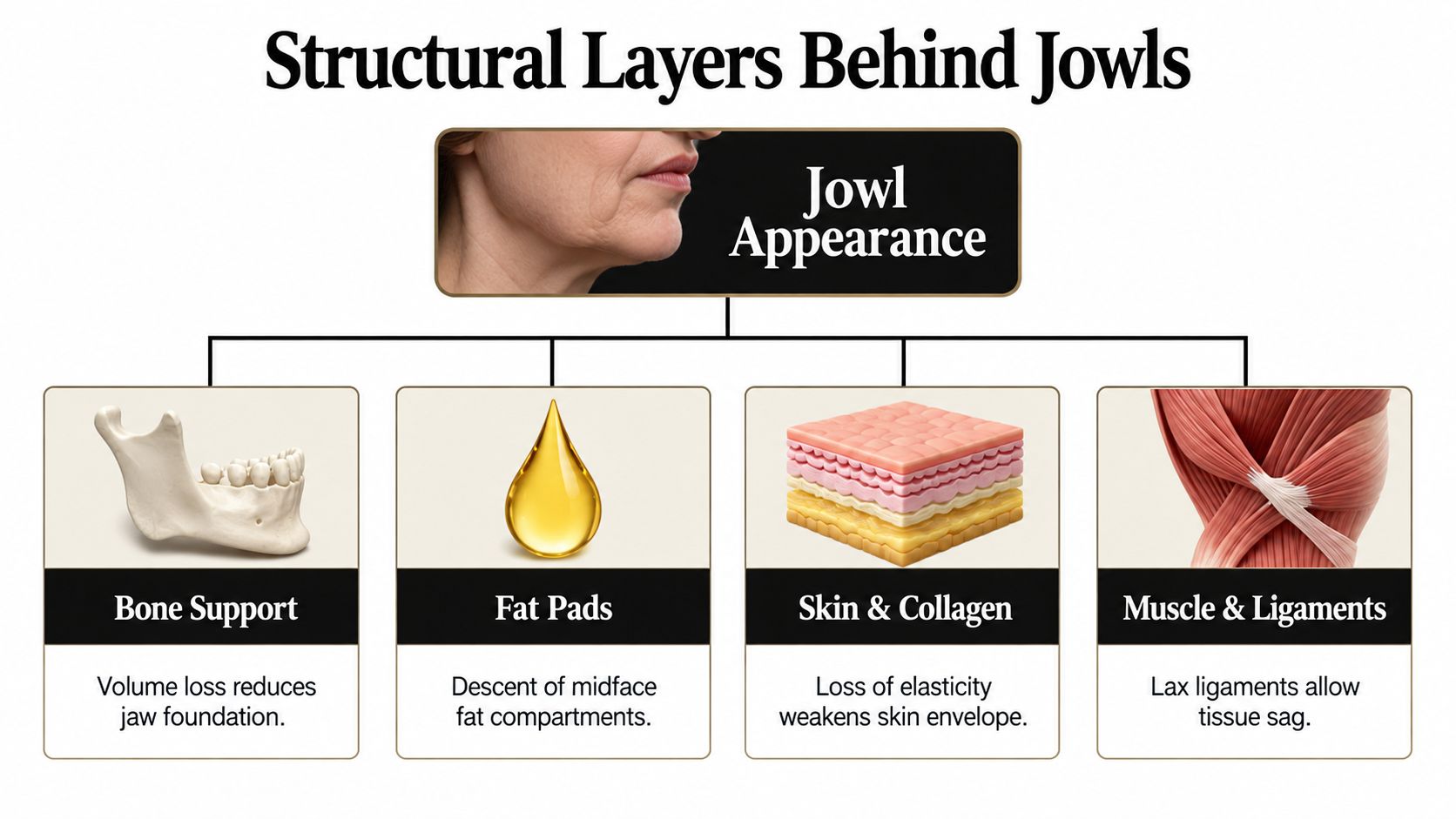
Think of the lower face like a house. The skin is the outer finish, the fat pads are the cushioning inside, the ligaments are the anchor points, and the bone is the foundation. When one layer weakens, the others have to carry more load. When several layers change together, the jawline starts to look softer and less contained.
Bone support and facial foundation
Independent medical literature describes jowls as a multi-structure change, not just a skin problem, involving facial remodeling in the lower face and jaw area, including bone support changes and platysma-related jawline changes, along with ligament changes that affect the way tissue sits on the face PMC review. That matters because if the underlying framework is shrinking, the skin has less support to drape over. In plain terms, the shelf gets smaller, so the fabric hangs differently.
Fat pads, ligaments, and skin
A Canadian plastic-surgery source explains that ultraviolet radiation, pollution, and intrinsic ageing reduce collagen stores in the dermis, while fat cells and muscle tissue shrink and descend, which creates uneven contours and bulges along the jawline Dr. DeKleer. A Canadian dermatology source adds that jowls reflect structural changes in both bones and soft tissues of the cheeks and lower face, plus decreased skin elasticity and diminished collagen, which allows tissue to droop into visible jowls Dermlab.
That same layered view helps make sense of why weight loss can sometimes make the jawline look sharper in one person and more hollow or loose in another. If you want a practical external read on the weight-loss side of that topic, the practical guide from Weight Method is a useful companion piece.
The hardest part for readers is this: the face doesn't age in one lane. It ages in several, and the lane that changes first isn't always the one you notice first.
How Jowls Progress Over Time
Jowl formation usually feels sudden only because several slow changes line up at once. The skin has already lost some resilience, the lower face has already lost support, and then one day the jawline looks noticeably softer in a photo or under overhead light. What feels abrupt is often the point where the cumulative change becomes visible.
Why the timeline seems uneven
Canadian clinic sources consistently describe jowls as a gradual process shaped by ageing, gravity, genetics, and environmental stress rather than one isolated event ICLS. That's why people often talk about “waking up to it,” even though the face has been changing for years. The actual timeline is less like a switch and more like a dimmer that slowly lowers the definition around the jaw.
Early signs that tend to come before obvious jowls
Before a clear fold appears, people usually notice smaller clues. The lower face may look less crisp from the front, side angles may show a softer transition from cheek to jaw, and the area beside the chin can appear less supported. Those are often the first signs that the face is losing both elasticity and structural fullness at the same time.
A useful way to think about it is this. If the upper face is still familiar but the lower face looks less anchored, the change is often happening in support structures rather than in the surface alone. That's why the same skin-care routine can seem to “work” on the cheeks while doing very little for the jawline.
Why timing matters
Earlier awareness doesn't mean panic. It means you can make better decisions before the change becomes harder to address. If your jawline already looks different in multiple lighting conditions, or if you're noticing the change from several angles rather than one, you're probably past the very first stage and into the period where personalised assessment becomes more useful than guesswork.
Lifestyle Factors That Accelerate or Prevent Jowls
Some habits put extra strain on the jawline, while others help slow it down. The biggest factors are smoking, sun exposure, and major weight changes, because each one affects a different layer of support. Smoking is consistently described as damaging collagen and elastin, the proteins that help skin stay resilient, and UV exposure gradually breaks down that support as well. That is why these habits matter even when the skin still looks fine at a glance.

What to protect first
If you want to protect the jawline, start with the habits that damage structure fastest. Smoking works against the skin's ability to bounce back, and repeated sun exposure slowly weakens the framework that keeps the lower face looking firm. Even if you do everything else well, these two factors can keep pulling the jawline forward.
Why weight changes matter more than people expect
Rapid weight loss can reduce the volume under the skin, leaving less support for the lower face. The skin does not always shrink at the same pace as the body changes, so the jawline can look softer or less defined. That is especially noticeable when support was already limited before the weight change.
The same idea shows up in discussions of losing menopausal belly fat. Body changes do not stay in one region. When the volume shifts elsewhere, the face can show it too.
What actually helps day to day
Avoid smoking: It directly works against the collagen and elastin your jawline depends on.
Use sun protection consistently: UV exposure is a real structural stressor, not just a skin-tone issue.
Keep weight changes gradual when possible: The face usually handles slower change better than rapid swings.
Treat topical care as support, not a lift: Creams can help the skin feel healthier, but they cannot rebuild a changing jaw foundation.
Treatment Options for Changing Jowls
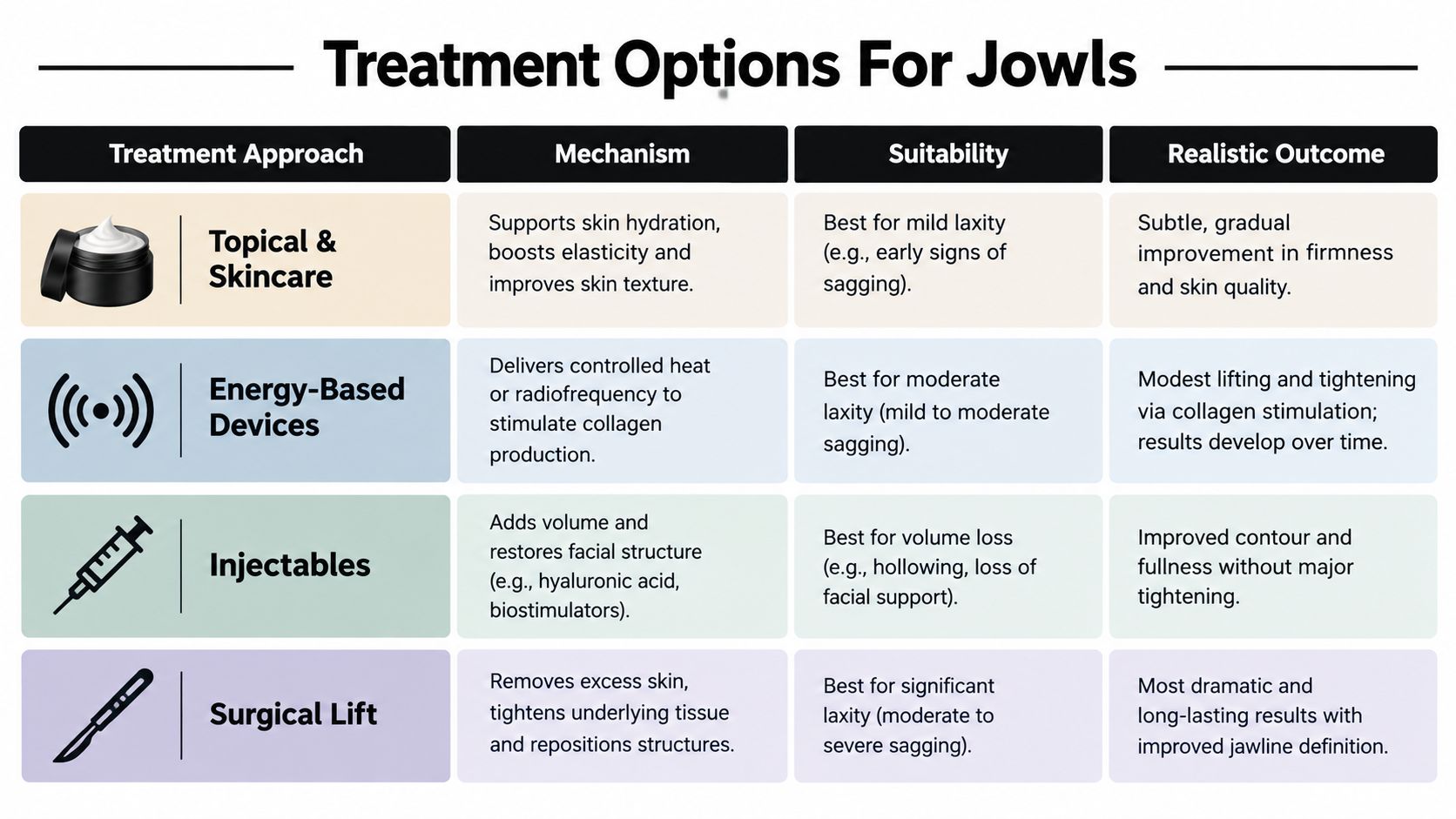
By the time jowls are visible, the right option depends on which layer is driving the change most. If the issue is mainly surface laxity, one approach makes sense. If volume loss or deeper sagging is more obvious, another approach fits better. That's why treatment conversations should feel anatomical, not cosmetic buzzword driven.
Matching the treatment to the problem
A useful framework is simple: surface support, collagen stimulation, volume restoration, and structural lifting. Topical care and medical-grade skin care sit in the first category. Energy-based devices fit the collagen-stimulation lane. Injectables are often used when contour has been lost. Surgical lifting addresses more significant laxity and deeper structural descent.
Comparing the main approaches
Topical and skincare-based options can support the skin's appearance, especially when laxity is mild, but they work gradually and modestly. Energy-based devices are often used when there's mild to moderate laxity and the goal is to encourage firmer-looking tissue over time. Injectables can help when the lower face has lost shape, because they address contour rather than just the skin envelope.
For readers comparing non-surgical options, the XERF vs Thermage vs Ultherapy guide is a practical way to understand how different tightening platforms are positioned. And if someone is trying to sort through broader anti-ageing claims, the conversation around feel younger with organic supplements can be helpful mainly as a reminder that internal wellness is not the same thing as structural correction.
Realistic expectation: if a treatment claims to tighten everything equally, it's probably oversimplifying. The lower face often needs the right layer addressed, not just a stronger promise.
Where professional care fits
Skinsation Aesthetics Inc. offers medical facials, hydradermabrasion, dermaplaning, advanced microneedling, chemical peels, laser rejuvenation, IPL skin rejuvenation, skin tightening, and collagen-stimulating therapies, which can be part of a broader plan when the concern is early lower-face skin quality rather than a severe structural change. The right mix depends on what's driving the jawline shift, not on a one-size-fits-all menu.
When to Seek Professional Consultation
If you're still wondering whether the change is “enough” to act on, that's often the right time to ask a professional. Jowls are easier to assess when someone can look at the face from the front, side, and in motion, because the jawline rarely behaves the same way in every angle or every light. A consultation is less about confirming a flaw and more about identifying which structure needs attention.
Good reasons to book an assessment
If the lower face looks different in photos than it does in your memory, if makeup sits differently along the jaw, or if your profile keeps catching your eye, a consultation can help you separate skin laxity from volume loss or neck softness. That distinction matters because different changes call for different tools. It's also why people in London, Ontario often benefit from seeing a local provider who understands facial structure and can match treatment to anatomy.
What to ask before you commit
A strong consultation should answer a few practical questions. Which layer is driving the change. Is the issue mostly surface, volume, or deeper support. Which options are realistic for your face right now. And what kind of maintenance would each option likely require.
Ask for the simplest explanation first. If the reasoning is clear, the plan usually is too.
If you want to prepare better for that conversation, these questions to ask before booking RF microneedling are a smart place to start, even if you're still deciding whether RF is the right category at all. Skinsation Aesthetics in London, Ontario is one local option for that kind of personalised assessment.
If you're ready to talk through what's changing in your jawline, Skinsation Aesthetics Inc. offers personalised skin consultations and a range of treatments that can support skin quality, collagen stimulation, and lower-face refinement. Visit Skinsation Aesthetics Inc. to explore what fits your face, your goals, and the level of change you're seeing now.
Comments