

Tech Neck Lines in Your 20s: Causes and How to Smooth Them

You're reading this on your phone, chin tucked toward your chest, and the front of your neck is folded into two or three horizontal creases. Lift your head and look in a mirror. If the lines fade, you're seeing movement. If they stay, you're seeing skin that has been folded in the same place long enough to keep the mark. Both versions deserve a plan, and they aren't the same plan.
What Tech Neck Lines Are and Why They Start Early
In our London clinic, a 24-year-old books a skin check and points to two faint lines across the front of her neck. They only show when she looks down at her phone. She wants to know if the phone did it.
The short answer: partly.
Tech neck lines are horizontal creases across the front of the neck produced by repeated neck flexion interacting with age- or sun-related loss of dermal resilience. The term describes a visible pattern, not a diagnosed disease. That distinction matters, because a pattern can be softened, reversed, or prevented depending on how early you catch it.

A sheet of paper folded the same way every day keeps the crease even when laid flat. Neck skin behaves similarly, and it is thinner than facial skin, so the fold registers sooner there than on the cheek. Flexion does the mechanical work. Sun exposure weakens the skin's ability to spring back, and time lowers its elasticity further. The phone starts the fold, but the other two factors decide whether it becomes permanent.
That is why these lines surface in the 20s and 30s rather than later in life. Screen habits start early and run all day, and a growing share of younger clients now book preventative care before lines set, which is the thinking behind our prejuvenation post on preventative treatment in your 20s.
The distinction that decides your plan: lines that come and go with movement respond to habit changes. Lines that stay visible at rest need treatment.
What Drives Neck Creasing and How Much Each Factor Matters
Every crease needs two things: a fold that gets pressed in, and skin that has lost enough spring to keep it. Each driver below feeds one side or the other, and that split decides whether a habit change or a treatment is the right tool.
Driver | How it adds to creasing | Can you change it? |
|---|---|---|
Repeated neck flexion from screens | Folds and compresses the front of the neck many times a day | Yes, through screen height and posture breaks |
Sun exposure | Builds photoaging in neck skin over years | Yes, with daily protection |
Intrinsic ageing | Reduces skin resilience and elasticity over time | Not fully, but in-clinic treatment can help |
Smoking | Linked to skin changes that make lines look more pronounced | Yes, by quitting or cutting back |
Dryness | Makes fine creases more visible on the skin surface | Yes, with consistent moisture |
A Canadian smartphone-use study reported that 64% of Canadians used a smartphone at least once per hour in 2020, according to the Canadian smartphone-use and posture research. That frequency explains how the fold gets rehearsed all day. It says nothing by itself about who ends up with permanent lines, which is why screens are only one row in the table.
Sun is the driver that gets skipped most often. The Canadian Dermatology Association's photoaging guidance names the neck as a prominent site of photoaging and recommends daily broad-spectrum SPF 30 or higher, not just holiday coverage. A common pattern is sunscreen that stops at the jawline, and because UV damage is slow and cumulative, the neck keeps score for years.
Ageing and UV work over years, so early creasing usually reflects a mix of habit and skin condition rather than one bad posture. Smoking and dryness make existing lines read deeper. Skin also ages with the rest of the body, and general health plays a supporting role; readers helping an older parent think through nutrition may find this guide to vitamins for older adults useful background.
On weighting: in your 20s and 30s, flexion and sun do most of the work, because the skin still has enough resilience that only repeated folding or cumulative UV wears it down. Intrinsic ageing matters more later, when the same daily habits etch faster because the skin recovers less between them. Change the rows you can change now, and let the rest be a reason to start early.
Daily Habits That Slow Repeated Neck Folding
Six habits, in the order I'd add them. None of them rebuilds collagen you've already lost. All of them reduce how often the same fold gets pressed in.
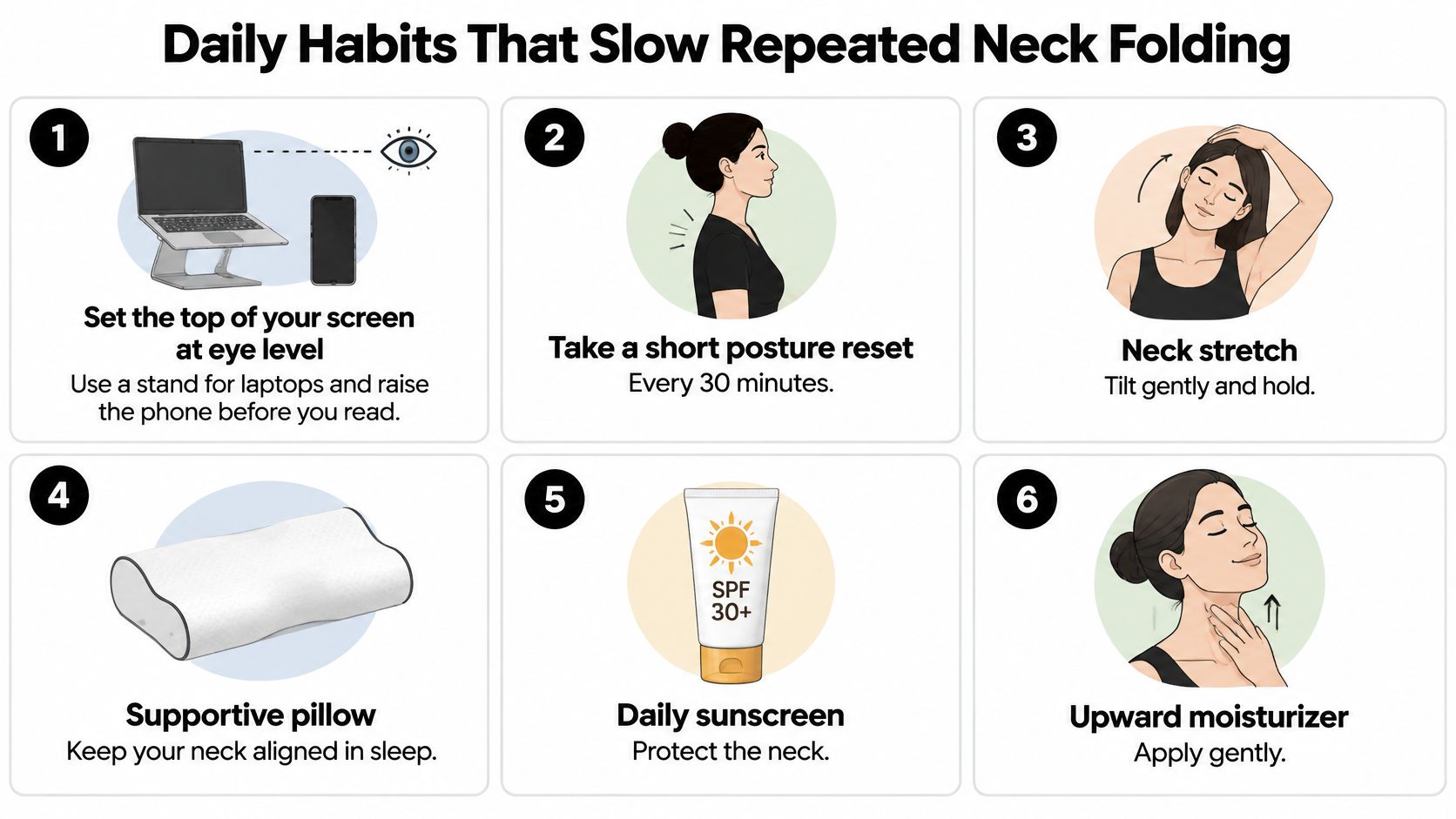
Raise the screen. Put the top of your monitor at eye level with a laptop stand and separate keyboard, and lift the phone before you read instead of dropping your chin. Fewer folds per day means less repeated creasing.
Reset your posture regularly. Every 30 to 60 minutes, lift your head, roll your shoulders back and sit tall for a few seconds. Set a timer, because you won't remember otherwise.
Sunscreen the neck and chest. Broad-spectrum SPF 30 or higher every morning, reapplied on long outdoor days. This protects against cumulative damage rather than smoothing anything today.
Carry moisturizer downward. Jaw to neck to chest, twice daily. Supple skin shows fine creases less.
Skip face-down sleeping. Pressing your face into a pillow folds the neck for hours at a time. A supportive pillow that keeps your neck aligned is the cheaper fix.
Cover up in glare. Sunglasses and a brimmed hat for winter sun and long commutes, when squinting and looking down stack into the same pattern.
In our London clinic, the clients whose lines look better at their next visit are the ones who kept these habits for months, not days.
Topical Care and What Products Can and Cannot Do
The base layer
Sunscreen and moisturizer, extended past the jaw. For body and neck coverage that doesn't feel greasy under a collar, we stock Sunforgettable Total Protection Body Shield Classic SPF 50.
Serums and retinoids, with the limits attached
A 2020 double-blind, placebo-controlled trial by dermatologists in San Diego tested a hyaluronic-acid serum with an antioxidant cream for visible neck aging, and the published neck rejuvenation trial reports that both the active and placebo groups improved on wrinkles, laxity, pigmentation, erythema, dryness and texture. Don't credit the bottle alone.
A 2023 controlled evaluation reported statistically significant improvements in neck lines, crepiness, texture, firmness and elasticity after 16 weeks with a multi-ingredient retinol treatment, per the controlled neck retinol evaluation. That's one formula, not every retinol on the shelf. Neck skin is more reactive than facial skin, so start twice weekly, patch-test behind the jaw, and don't copy your face routine downward. Retinoids should be avoided during pregnancy, so check with your clinician first. If you're comparing formulas, this Skin Perfection neck skin tightening cream guide explains what ingredient labels promise. Topicals improve surface quality and support in-clinic results. They don't fill an etched groove.
XERF and Microneedling for Neck Lines Compared
Two different tools, two different jobs. The right pick depends on whether your neck needs tightening or resurfacing.
Treatment | Best for | Needles | Downtime |
|---|---|---|---|
XERF | Firmness and tightening of face and neck skin | No | No downtime |
Microneedling | Texture and fine lines on the neck | Yes, fine needles | Typically 1 to 3 days of redness |

XERF is a dual-frequency radiofrequency treatment that lifts, firms and smooths the face, neck and body without surgery. No needles are involved, and I tend to suggest it when looseness, not a deep crease, is the main concern. You can read the protocol on our XERF face and neck service page.
Microneedling uses fine needles to create controlled micro-injury, which triggers the skin's own repair response. That response smooths crepey texture and softens fine lines, so it fits a surface problem better than a fold or a sagging jawline. Sessions feel like light scratching, and the pinkness afterwards usually settles within a few days.
A prospective evaluation of combined adjustable-depth fractional radiofrequency and bipolar radiofrequency included 247 patients treated for neck laxity and jowling, and 93% reported being pleased with their results and willing to undergo the procedure again, according to the published combined radiofrequency study.
That study tested a specific combined radiofrequency approach on laxity and jowling, not XERF, and not fine horizontal lines in a 28-year-old. Treat it as evidence that protocol matters, not as a promised result.
If your main concern is jawline looseness or under-chin softness, our post on jowls and neck laxity with XERF is the better read. For at-home devices, this Finding Favourites on affordable light therapy shows what a home tool realistically does. After either treatment, follow your specialist's sun and skincare instructions, and tell us if you're pregnant or planning to be.
What Results to Expect and How Long They Take
Deep set creases soften. They don't vanish. Early lines that appear only in certain head positions respond best, which is the whole argument for treating sooner rather than later.
Sort your neck into categories before you pick a treatment:
Dynamic creasing: visible with movement, driven by folding, most responsive to habit change and early intervention.
Etched-in lines: present at rest, needing collagen-stimulating treatment rather than a cream.
Laxity: loose, draping skin, which is a tightening problem.
Pigmentation: mottled colour from sun, treated separately from the lines themselves.
Timeline and maintenance
Skin feel and surface texture change first. Firmness takes several weeks to show, so judge at your follow-up, not the next morning. A prospective study of radiofrequency microneedling for the lower face, jawline and neck treated 30 participants with a mean age of 55.5 years, using one to three treatments at intervals of four to 12 weeks, and reported a mean submental volume change of -4.72 cm3 with a range from -26.65 cm3 to +16.01 cm3, in the clinical study indexed by the National Library of Medicine. The authors concluded it was safe and effective for the regions studied. Those participants were older than our early-line clients, so it isn't proof of prevention in your 20s. Our microneedling treatment overview explains the texture side. Results hold longer when posture and sun habits continue, and your specialist sets the maintenance schedule after assessment.
Common Questions About Neck Lines Answered
What causes tech neck lines? Repeated neck flexion combined with sun exposure and intrinsic ageing, which is why the drivers table above matters more than any single habit.
Can you get rid of neck lines without surgery? Non-surgical treatment often softens lines and firms skin, but deep creases rarely disappear completely. Match the option to your line type.
At what age do neck lines start? In our London clinic we see early lines in clients in their 20s and 30s, usually visible only with the head down, with ageing becoming a bigger factor over time.
How many sessions are needed? It depends on the treatment, the depth of the line and how your skin responds. Some plans are a single visit, others a short series, set after your assessment.
Bring the question you're actually asking, whether that's "why is this here at 26" or "can it go away," and you'll get a straighter answer than any product page gives.
Book Your Neck Consultation in London, Ontario
A neck consultation at Skinsation Aesthetics Inc. in London, Ontario, helps separate what habit changes can address from what XERF or microneedling may soften. Our certified skin care specialist recommends a procedure suited to your skin requirements.
Bring photos with your head upright and chin tilted down to compare creases at rest and during folding. For younger clients, the discussion should distinguish repeated folding from sun exposure and ageing, rather than treating every line alike.
Rough, scaly, bleeding or changing patches need medical assessment first. Tell the team if you're pregnant before treatment.
Explore the XERF treatment page, then book online through Skinsation Aesthetics Inc. or call 877-754-6728 to discuss your neck concerns and suitable next steps.
Comments