

Laser Hair Removal Ears: What London Clients Should Know

You've trimmed the hair along your ear rim, checked it in the mirror, and spotted another strand you missed. If you're searching for laser hair removal ears, the first distinction matters more than the appointment length: we assess visible hair on accessible outer ear skin, never inside the ear canal. In our London, Ontario clinic, the useful question isn't whether laser can remove ear hair. It's whether your particular hairs have enough pigment to respond safely.
Why Ear Hair Becomes More Noticeable Over Time
An ear consultation often starts with a practical frustration: you can reach the hair, but you can't see it properly while you're trimming. The rim curves away from the mirror, and a strand that looked short from the front becomes obvious from the side.
Ear hair can become more noticeable over time as its appearance changes. Longer or coarser strands stand out against the skin, while pale hairs may catch the light even when they're difficult to see close up. That doesn't mean every visible strand is suitable for laser.
The grooming options each involve a compromise:
Small scissors or a guarded trimmer: Useful for shortening visible hair, but they don't address future growth. Keep tools outside the canal.
Tweezers: Precise for an isolated strand, but awkward on curved skin and uncomfortable when several hairs need attention.
Waxing or threading: These involve pulling hair from a delicate, difficult-to-access area. They aren't an automatic improvement over careful trimming.
Practical rule: Wanting less maintenance is a reasonable goal. It doesn't mean every hair needs treatment.
Laser appeals because it aims for longer-term reduction rather than another temporary tidy-up. But if most of the hair bothering you is grey, the honest consultation may end with a recommendation not to pursue laser.
What Areas Around the Ear Can Be Treated with Laser
We define the treatment boundary before discussing a course of appointments. “Ear hair” isn't a precise enough description for consent or a quotation.
Accessible external skin may be assessed, including the outer ear, rim or helix, lobe, external tragus, and small patches behind the ear. Assessment doesn't mean every surface can be treated: the operator needs clear access, controlled positioning, and an appropriate treatment angle.
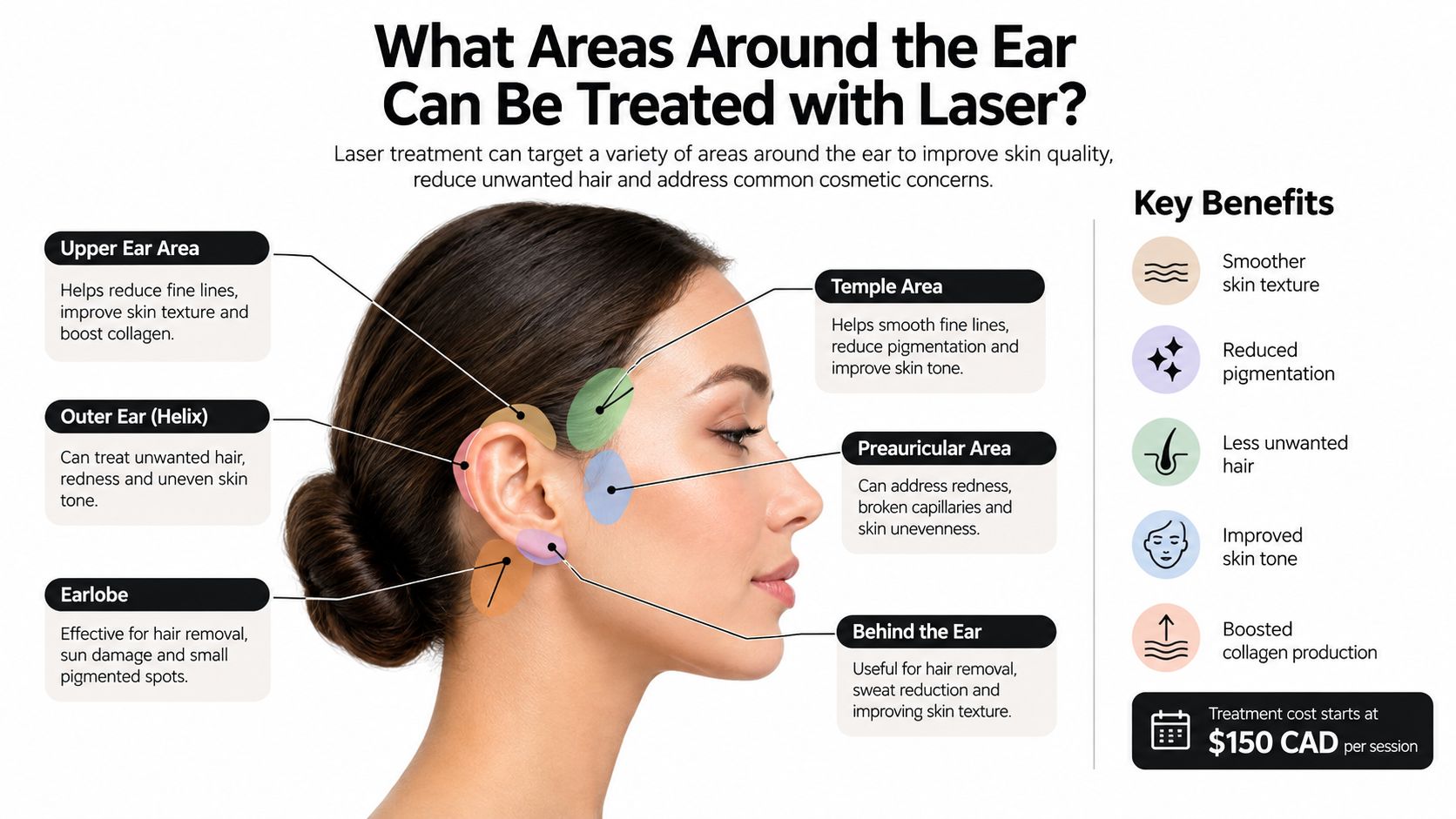
Where treatment stops
We don't insert a laser handpiece into the ear canal. A hair protruding from the canal doesn't make its origin an appropriate cosmetic treatment site.
Health Canada's laser hair removal safety guidance identifies hair-removal lasers as high-hazard Class 3B or Class 4 devices, with exposure capable of causing permanent eye injury or skin burns. Those hazards require controlled beam placement, suitable protective eyewear, and trained operation, not improvisation around an opening.
Protective eyewear protects eyes; it doesn't make internal ear treatment safe. The thin, curved external skin also calls for precision rather than treating the ear as a smaller version of a leg or back.
If you can't tell whether the unwanted hair grows from external skin or deeper inside, leave that distinction to the assessment.
How Laser Targets Ear Hair and Who Is a Good Candidate
Hair colour and skin colour must be assessed together. Dark, coarse strands may offer a useful target, while a nearby white strand may offer almost none.
The mechanism is called selective photothermolysis. Health Canada explains how laser energy targets follicular melanin: infrared energy is absorbed by pigment and converted to heat that damages the follicle, while surrounding skin absorbs less energy. Our Canadian guide to how laser hair removal works explains that process in everyday terms.
That mechanism sets a firm limit. Grey, white, very light, and fine ear hair responds poorly. Turning up the energy isn't a sensible workaround for missing pigment. With mixed dark and grey hair, the practical aim may be reducing the dark strands while leaving the grey ones unchanged.
A suitable treatment plan starts with the hairs laser can target, not the hairs you most want gone.
Deeper skin tones require appropriate wavelength selection and individualised settings. Disclose recent tanning, self-tanner near the ears, medications, and changes in your skin before treatment. We shouldn't choose settings from hair colour alone.
If you're also researching facial rejuvenation, Skin Perfection's resource lets you compare laser facial treatment options. Keep that comparison separate from ear-hair candidacy: a device used for facial resurfacing isn't interchangeable with a hair-removal treatment.
What an Ear Laser Session Actually Feels Like
In our London, Ontario clinic, the appointment should begin with questions, not laser pulses. Tell us about medications, recent sun exposure, piercings, eczema, cuts, tenderness, or discharge around the ear. Mention earwax concerns too, rather than trying to clear the canal yourself before arriving.
The operator checks and cleans the external treatment area, identifies the intended zones, and fits appropriate protective eyewear. Piercings and reflective items need assessment before treatment proceeds. A test patch may be appropriate, and you should know how to signal for a pause before the handpiece approaches your ear.
Sensation and recovery
A pulse can feel like a brief snap or warm flick. Because the treatment patch is small, the active treatment can be quick, but small doesn't mean painless. Our guide to laser hair removal discomfort can help you prepare without expecting a sensation-free appointment.
During treatment: Stay still and ask the operator to stop if you need to cough, turn, or adjust your position.
After treatment: Downtime is generally minimal, but warmth, redness, or sensitivity can occur. Follow the instructions given for your skin.
If symptoms worsen: Blistering, crusting, pigment changes, and infection are recognised adverse effects in Public Health Ontario's personal-service infection-risk guidance. Seek medical review for suspected infection rather than treating it as ordinary recovery.
Session Counts, Spacing, and Realistic Results
A small treatment area doesn't bypass the hair-growth cycle. The plan needs repeat assessment because suitable hairs aren't all ready to respond at the same appointment.
A general Canadian framework is six to eight sessions spaced eight to twelve weeks apart, as described in the Canadian dermatology guidance referenced by Health Canada's cosmetic laser treatment information. This isn't an ear-specific prescription or a guarantee. Your provider should adjust the plan to your hair, skin, device, and observed response.
Typical Ear Laser Timeline at a Glance
Stage | Sessions | Spacing | Typical response |
|---|---|---|---|
Assessment | Before starting | Based on readiness | Establish candidacy and external boundaries |
Treatment course | Individualised within the general framework above | Adjusted after review | Assess reduction in suitable pigmented hairs |
Reassessment | As needed | Based on regrowth and skin response | Decide whether further treatment is worthwhile |
Maintenance | Only if indicated | Individualised | Address suitable remaining or returning hair |
Expectation check: Judge progress by reduced unwanted growth and easier maintenance, not a promise that every strand will disappear.
The total course extends over months even when individual appointments are brief. Maintenance may be appropriate, but it shouldn't be sold as a fixed annual requirement before anyone knows how you'll respond.
Pairing Ear Laser with Other Small Areas for Men
If you're already discussing unwanted facial hair, it's reasonable to ask about other small zones during the same consultation. The external nose rim, upper cheeks, sideburn edges, or back of the neck may be concerns alongside the ears. Brow-area requests require particular caution because of their proximity to the eyes.
Convenience doesn't establish suitability. Each proposed area needs its own assessment, and an external nose-rim discussion must never become permission to treat inside the nose. Likewise, settings suitable for one patch shouldn't be copied onto another.
Compare the plan, not just the appointment
Combining suitable areas may make scheduling easier. Treating only the ears keeps the decision narrower if you're uncertain about facial hair changes.
Our male hair-removal overview can help you identify the areas you want to discuss. Use the main laser hair removal service page to understand the broader service, then request a clear quotation for the agreed areas.
Ask whether the quotation is per area or packaged. Don't assume combining areas creates a discount, or that every requested facial zone is offered.
Common Questions About Laser Hair Removal on Ears
Can you laser ear hair?
Yes, suitable visible hair on accessible external skin can be assessed. The anatomical boundary described above is firm, and an assessment may exclude a difficult-to-access patch.
Does laser work on grey ear hair?
Usually poorly. If grey or white strands are your main concern, don't commit to a course expecting the response described for dark hair. Ask what improvement is realistically possible before booking treatment.
Is ear laser painful?
You may feel brief heat or snapping sensations. Tell the operator immediately if the sensation feels excessive, and don't move your head without first asking for a pause. Review the Canadian laser aftercare guide before your appointment so you understand recovery responsibilities.
How many sessions will I need?
Use the general framework above as a starting point, not a prepaid promise. Skin response, remaining pigmented hair, and worthwhile progress should guide later decisions. The Canadian men's laser hair removal guide offers broader planning advice if you're considering more than the ears.
Skinsation Aesthetics Inc. offers laser hair removal with individualised assessment, including a discussion of whether your external ear hair is a suitable target. To book a consultation in London, Ontario, call 519-933-8538 or visit Skinsation Aesthetics Inc., and we can discuss the treatment boundary, your hair colour, and realistic expectations before you commit.
Comments