

Laser Hair Removal Dark Skin Near Me: London on Guide 2026

Nd:YAG at 1064 nm and Aerolase Neo Elite systems are the laser technologies that fit dark-skin treatment best, and Skinsation Aesthetics in London, Ontario offers Aerolase treatments. For a client searching laser hair removal dark skin near me, the key question is whether the clinic matches the wavelength, settings, and supervision to your exact skin tone.
You've probably seen clinics promise results for “all skin tones” and wondered if that's real or just marketing. In darker skin, the safer path depends on the device, the operator, and the consultation, not on a generic promise.
Why Dark Skin Needs a Different Laser Approach
You search for laser hair removal dark skin near me, and the results all blur together. One clinic says it works for everyone, another says it's gentle, and a third throws in a device name without explaining why it matters. That's where people get misled, because the real issue isn't whether hair can be treated, it's how the laser interacts with the pigment in your skin.
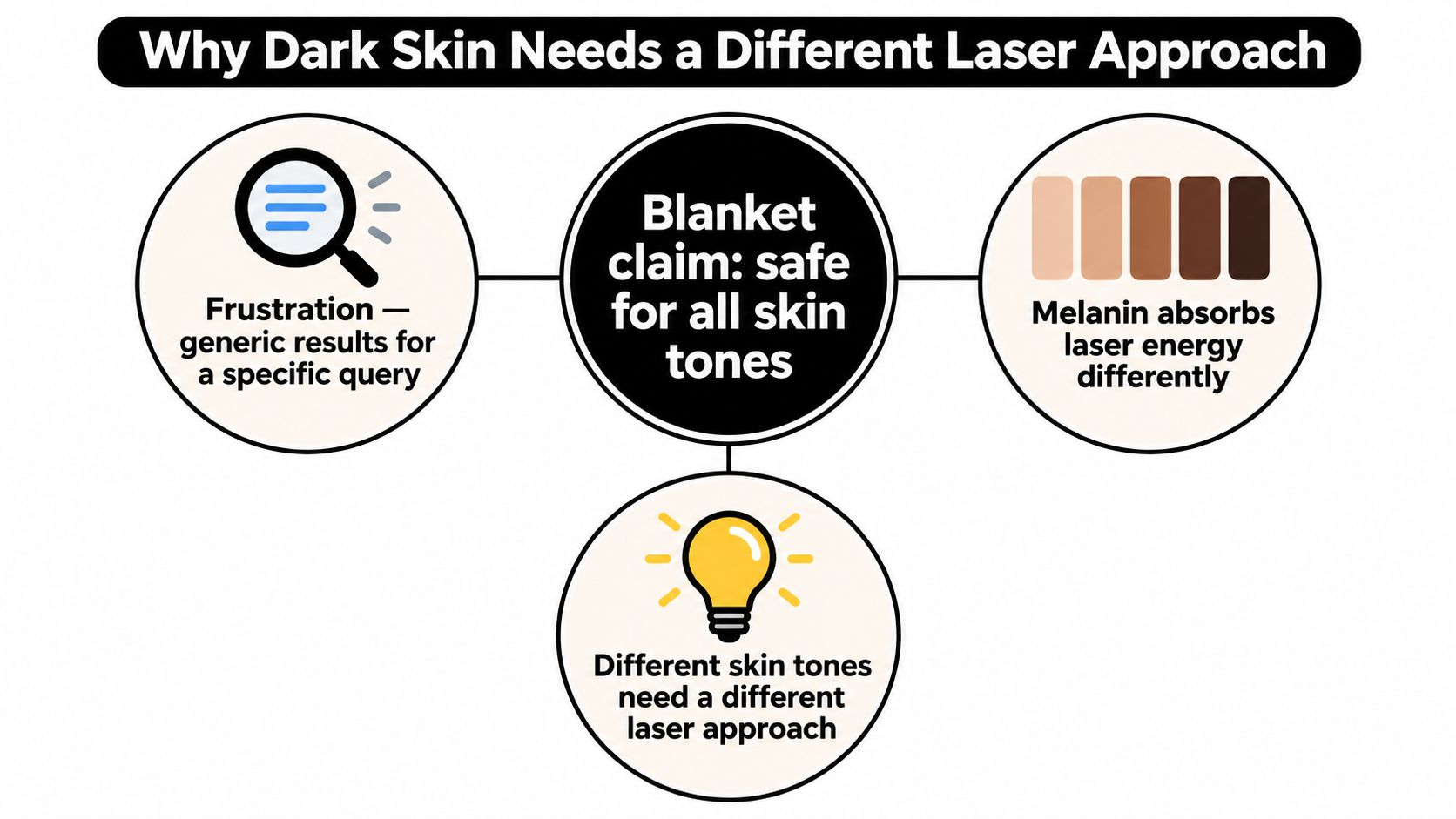
The part most ads leave out
Melanin in the epidermis acts like a second target. If a laser wavelength is too easily absorbed by skin pigment, some of the energy goes into the skin instead of the hair follicle, which raises the chance of burns or pigment change. Health Canada notes that hair reduction is generally less effective on dark skin because surrounding melanin can absorb treatment energy, and the Canadian Dermatology Association warns about burns, blistering, scarring, and temporary or permanent pigment changes in darker or tanned skin. Those cautions are why technology selection is safety, not an upgrade.
That's also why a darker complexion isn't “untreatable.” It just needs a provider who understands wavelength choice, conservative settings, cooling, and patch testing as part of the plan. If you want a helpful overview of this logic from another provider, Omega Lasers' dark skin treatment guide lays out the same core concern, the laser has to target hair without overloading the surrounding skin.
Practical rule: if a clinic can't explain how it protects the epidermis, don't treat “safe for all skin tones” as a safety answer.
Why this matters in real life
Think of a client with curly facial hair, a history of ingrowns, and a medium to deep skin tone. They're not asking for a fashion treatment, they're trying to avoid bumps, dark marks, and irritation that keep coming back after shaving or waxing. The safest clinic will ask about recent tanning, medications, pigmentary history, and how your skin reacted after prior treatments, because those details change the settings.
For that reason, the most useful local question isn't “Do you do laser hair removal?” It's “Is your protocol right for my skin tone and hair profile?”
The Fitzpatrick Framework and Melanin Competition
Skin type classification gives the consultation some structure, but it doesn't replace judgement. The Fitzpatrick scale is useful because it helps a provider talk about how skin usually reacts to sun exposure, then match that with a laser approach that won't overheat the skin. For darker skin, the concern is usually Fitzpatrick IV, V, and VI, where epidermal melanin is more present and the margin for error is smaller.
Why wavelength matters more than hype
A simple way to think about laser energy is this, different wavelengths behave like different magnets. Shorter wavelengths are more likely to be absorbed by surface pigment, while longer wavelengths travel deeper and are less strongly absorbed by epidermal melanin. That is why 1064 nm Nd:YAG is usually the preferred choice for Fitzpatrick IV to VI, because it reaches deeper and reduces the chance of surface heating.
The trade-off is straightforward. If the wavelength is too aggressive for the skin tone, the skin absorbs more energy than it should. If the wavelength is chosen well, the hair follicle gets the focus and the surrounding skin is spared as much as possible.
Laser Type | Wavelength | Safety for Dark Skin | Primary Risk |
|---|---|---|---|
Alexandrite | 755 nm | Less suitable for deeper pigmentation | Epidermal overheating |
Diode | 810 nm | Depends heavily on settings and cooling | Burns or pigment change if misused |
Nd:YAG | 1064 nm | Preferred for Fitzpatrick IV to VI | Still needs careful settings and cooling |
The fitting question is not whether a machine has a famous name. It's whether the wavelength matches the skin in front of the provider.
Why the Fitzpatrick scale is only the start
A person can have darker skin and still be a very poor candidate for a given session if they're freshly tanned, taking photosensitising medication, or already dealing with irritation. That's why a provider should also ask about current pigmentation, active inflammation, and any prior post-inflammatory hyperpigmentation. Skin type gives the frame, but the consultation fills in the remaining details.
People often get confused here. They hear that a laser is “good for dark skin” and assume that means every setting, every day, every client. It doesn't. A technically sound clinic uses the Fitzpatrick category as a starting point, then adjusts based on the actual skin tone, hair profile, and recent exposure.
Nd - YAG and Aerolase - The Technologies That Work for Dark Skin
The useful comparison is simple. Nd:YAG gives you the long wavelength advantage, and Aerolase Neo Elite uses the same 1064-nanometre wavelength with a very short pulse duration. That combination matters because dark skin care is about limiting unnecessary heat while still reaching the follicle.
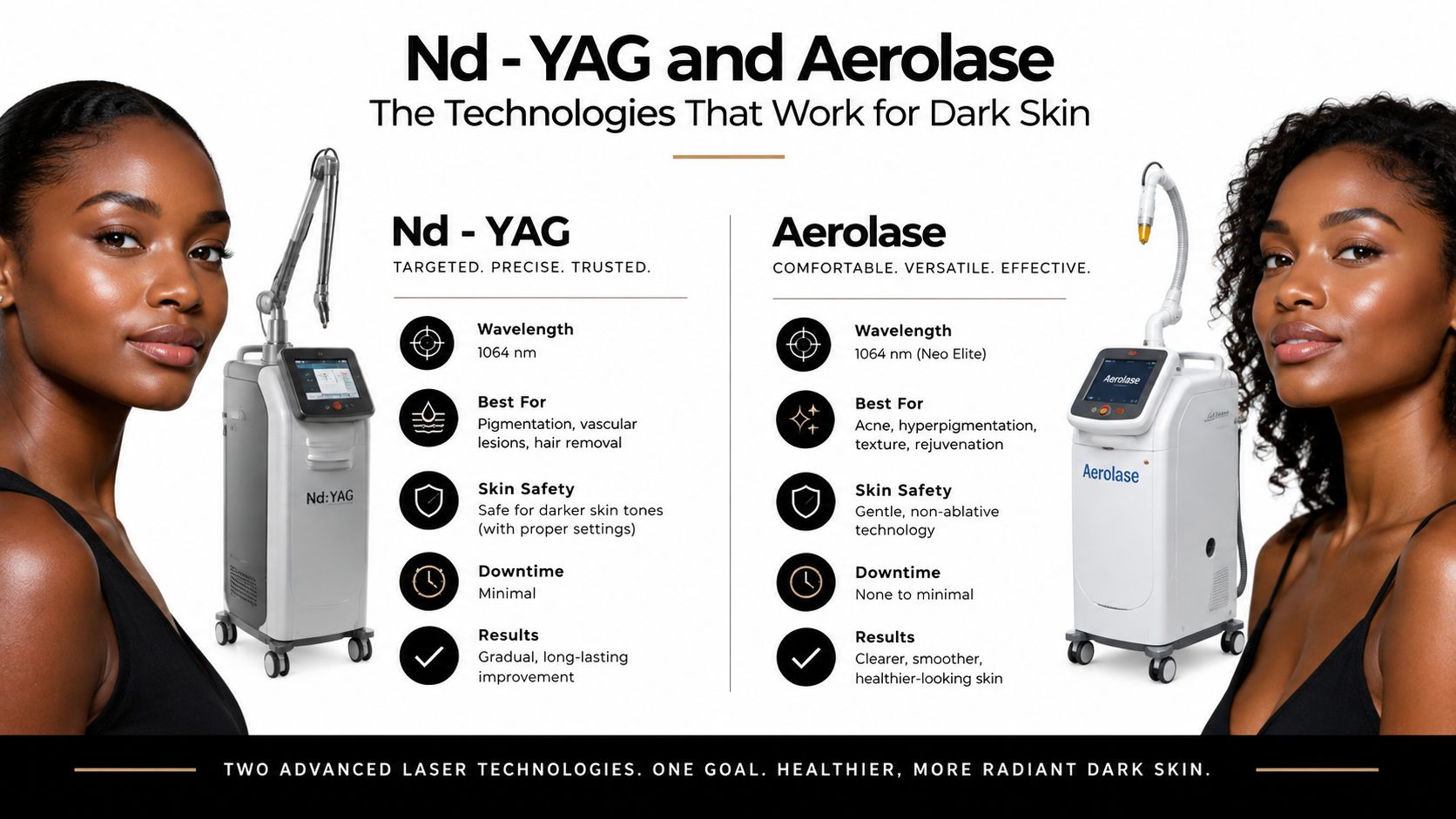
What Aerolase adds
Aerolase describes the Neo Elite as using a 1064-nanometre Nd:YAG wavelength with a 650-microsecond pulse duration, and says the system is intended for Fitzpatrick skin types I through VI, including darker skin tones. The manufacturer also says the short pulse is designed to reduce thermal damage and the risk of post-treatment hyperpigmentation compared with systems that deliver more heat to melanin-rich skin. Skinsation Aesthetics' Aerolase technology page is a useful internal read if you want to see how that technology is presented in a clinic setting.
That doesn't mean the device does the thinking for the provider. It means the provider has a tool that can be matched more carefully to melanin-rich skin. The pulse duration is part of the safety story, but it still needs a trained operator, correct spacing, and a sensible starting point.
Why the booking menu matters, but only partly
Skinsation Aesthetics' Canadian booking page shows Aerolase as an offered modality in London, Ontario, with bookable treatments for psoriasis, melasma, and hyperpigmentation. That confirms the clinic uses Aerolase, but those listed services are not the same thing as hair removal. The menu proves the technology is there, while the consultation determines whether the hair-removal plan is the right application.
A good client question is, “Do you use the same wavelength family and safety logic for hair removal, and how do you adjust it for my skin?” That's a better question than asking whether the device sounds advanced. A clinic that can answer clearly is usually more useful than one that only advertises a brand name.
What to compare before you book
Wavelength: ask whether the device is operating at 1064 nm for darker skin.
Pulse behaviour: ask how the pulse duration changes the heat delivered to skin.
Cooling: ask what protects the epidermis during treatment.
Scope of use: ask whether the clinic uses the same platform for pigment concerns and hair reduction, and how that translates into a hair-removal protocol.
Safety Risks When the Wrong Laser Is Used
The common myth is that laser hair removal is either safe or unsafe. That's too blunt. The key divide is between correctly matched technology and mismatched technology, because the wrong device can make melanin-rich skin pay the price for a poor choice.
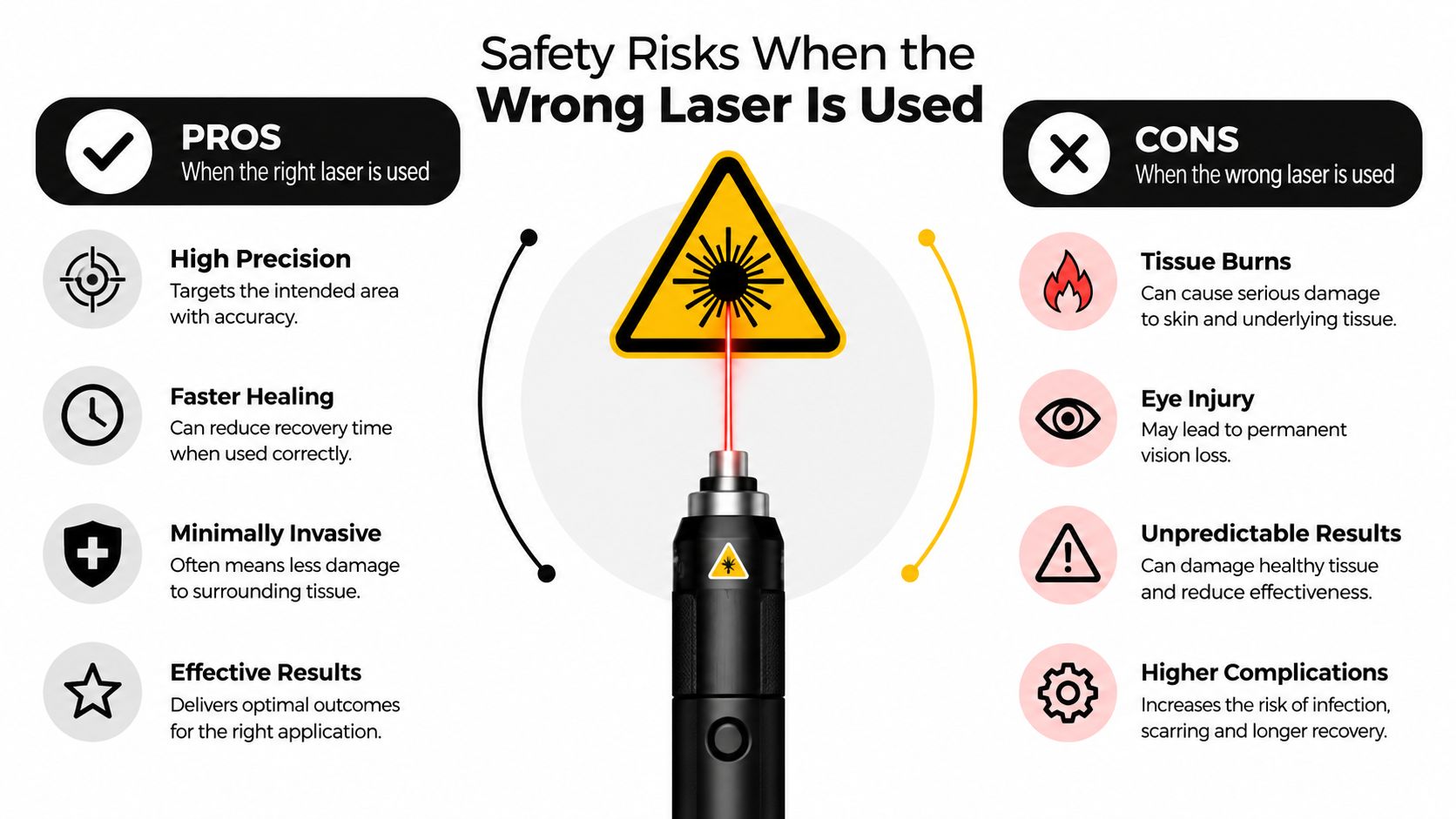
What can go wrong
When an Alexandrite or poorly managed diode treatment is used on darker skin, the epidermis can absorb too much energy. That can show up as burns, blistering, post-inflammatory hyperpigmentation, hypopigmentation, scarring, or eye injury if protection is weak. Health Canada's safety guidance also classifies hair-removal lasers in Canada as Class 3B or Class 4 devices, which is a reminder that these are not casual beauty tools.
Cooling is not cosmetic. It's a control measure. Contact cooling, cryogen spray, or chilled air helps protect the top layer of skin while the follicle is targeted, and without it, the comfort and safety profile changes fast.
Why “safe for all skin tones” can be a weak claim
A clinic can say the treatment is safe, but safety comes from procedure, not slogan. If they can't tell you the wavelength, if they can't explain their cooling method, or if they don't describe how they handle recent tanning, that promise isn't doing much work. Dark skin isn't automatically off-limits, but it is easier to mistreat when the operator treats every client the same way.
Red flag: if the booking pitch is smoother than the consultation, the clinic is selling confidence, not necessarily competence.
The Canadian Dermatology Association's warning about burns, scarring, and pigment change matters for another reason too. It helps explain why many experienced providers use lower starting fluence on deeper skin tones, then build cautiously. That kind of patience can feel slower, but it's the difference between thoughtful treatment and skin damage.
What a safer appointment looks like
A proper visit includes a skin assessment, discussion of current tan status, and a patch test when needed. It also includes clear eye protection and a practitioner who knows when not to proceed. If a provider seems rushed, vague, or annoyed by questions, that's a signal to pause.
What to Ask Before Booking a Consultation in London Ontario
London-area clients need a checklist, not a cheerleading speech. Ontario doesn't have laser-specific licensing, so the burden shifts to the clinic's training, supervision, and internal safety standards. That makes your questions more important than the brochure.
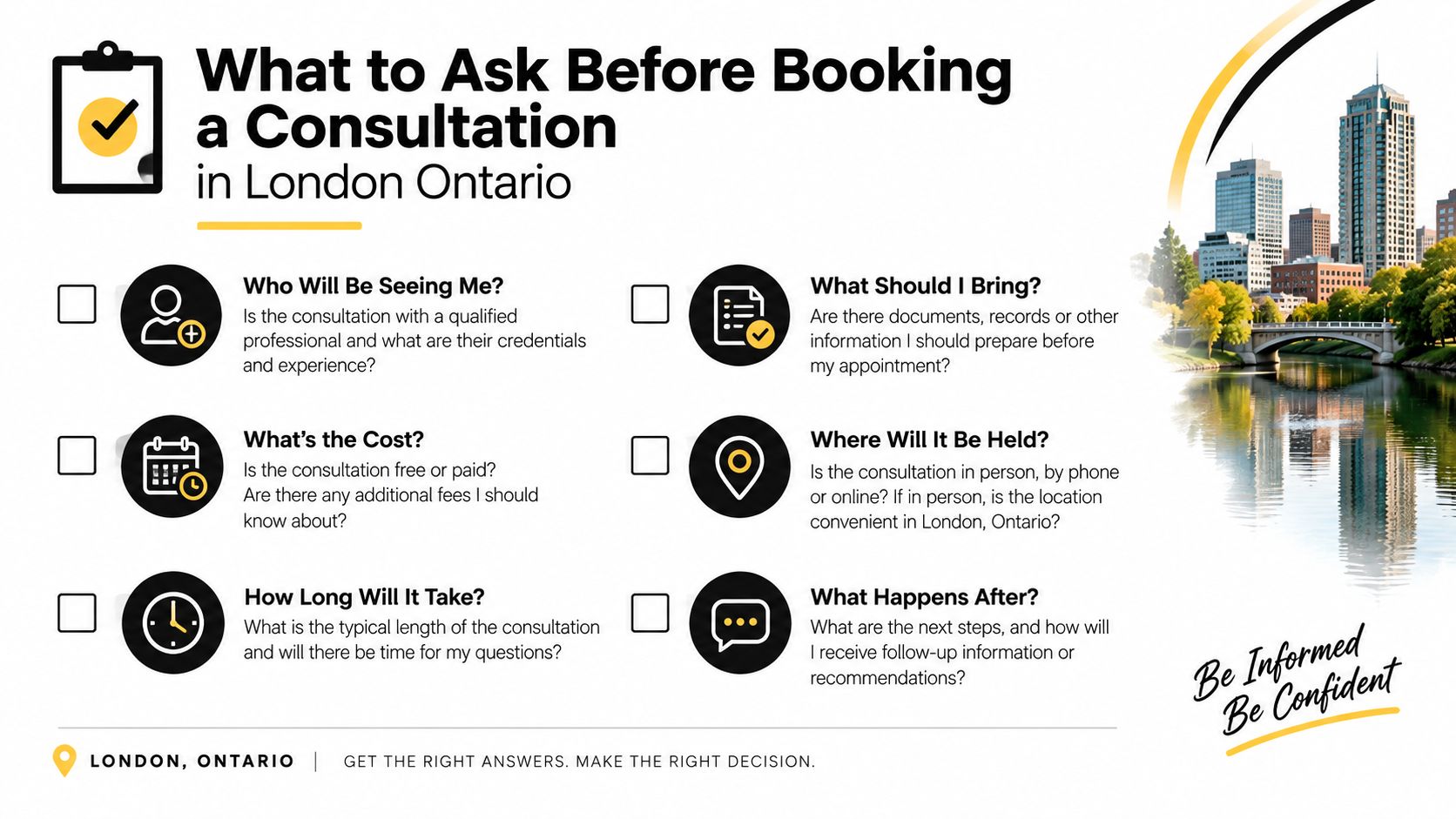
Questions that separate informed from unprepared
Start with the wavelength. Ask, “What wavelength does your device use for darker skin, and why?” Then ask whether they can show you before-and-after examples for Fitzpatrick IV to VI clients, because experience with melanin-rich skin should be visible, not implied.
Next, ask about test patches and cooling. A clinic that understands darker skin should be able to explain whether they patch test, how they cool the skin, and how they adjust settings for a current tan or any pigment history. If the answer is vague, the protocol is probably vague too.
Who is actually treating you
The Medical Board of California says physicians may use lasers or intense-pulsed-light devices for hair removal, while registered nurses and physician assistants may perform these procedures only under physician supervision, and unlicensed medical assistants, vocational nurses, cosmetologists, electrologists, and estheticians may not perform them. That's a California rule, but the principle is relevant everywhere, because the person holding the handpiece needs the right license and the right oversight.
Ontario's consumer should ask two things. First, who is the treating practitioner. Second, what supervision structure is in place if the procedure requires physician oversight. If you're unsure, ask how the clinic documents training and who reviews the protocol.
Best consumer habit: keep the conversation technical. Wavelength, cooling, patch test, supervision. Those four words tell you much more than “advanced” ever will.
If you want a place to start that conversation, Skinsation Aesthetics' consultation booking page is the kind of appointment format that lets the clinic review your skin tone, goals, and tolerance before committing to treatment.
What to ask in one short conversation
Wavelength: “Is this 1064 nm for my skin type?”
Cooling: “How do you protect the epidermis during treatment?”
Patch testing: “Do you test a small area first?”
Supervision: “Who is responsible for the procedure and oversight?”
Risk history: “How do you factor in tanning, medications, and pigment changes?”
Treatment Timeline, Aftercare, and Cost Considerations
Laser hair removal usually works as a series, not a one-off session. Hair grows in cycles, so a single appointment only reaches the follicles that are active at that time. For most clients, that means a structured plan, careful spacing, and a little patience between visits.
What to expect between sessions
A sensible plan often includes repeated sessions spaced several weeks apart, with shaving allowed between visits and waxing or plucking kept out of the routine. That matters even more for darker skin, because the provider may choose a gentler starting approach to protect the skin. The goal is not to rush the follicle into submission, it's to reduce hair safely while limiting pigment disruption.
After each session, the skin needs a low-drama routine. Keep the treated area out of strong sun, use gentle skincare, and monitor any patchy darkening or lightening. If you've had ingrowns and irritation for years, that aftercare is part of the treatment, not an optional extra.
Cost and the London context
Price depends on area size, technology, and the clinic's approach. A clinic using Aerolase or another advanced system may price differently because the equipment and training level are different from a basic cosmetic setup. For a local point of reference, Skinsation Aesthetics' booking page shows Aerolase psoriasis at $175, Aerolase melasma at $400, and Aerolase hyperpigmentation single-spot treatments starting at $150, which confirms the technology is active in the London, Ontario menu even though those are not hair-removal prices. Skinsation Aesthetics' package page is the better place to review hair-removal package structure directly.
Insurance usually doesn't treat hair removal as a medical necessity, so many clients budget it as a cosmetic investment. That's another reason to ask about the device, the number of sessions, and whether the clinic offers a structured package rather than a loose one-off plan.
Good budgeting rule: compare the treatment plan, not just the sticker price.
For darker skin, the smartest decision is usually the clinic that can explain the wavelength, show the supervision structure, and tell you how they'll reduce pigment risk over time. If a provider can do that, the appointment starts to feel like a medical-grade service instead of a beauty gamble.
Skinsation Aesthetics Inc. offers London, Ontario clients advanced laser care, including Aerolase-based services and consultation-driven treatment planning for skin concerns that need careful device selection. If you're comparing options for laser hair removal dark skin near me, visit Skinsation Aesthetics Inc. to review the clinic's services and book a consultation that fits your skin tone, goals, and safety needs.
Comments