

Laser Hair Removal During Pregnancy: A Clear Guide

We pause laser hair removal during pregnancy as a precaution, because pregnancy-specific research is limited, not because harm or safety has been proven. Speak with your doctor or midwife before you keep or cancel a visit.
Popular posts offer one of two lines. Either the laser will hurt the baby, or the light stays in the skin so the visit is fine. I wouldn't treat either line as something you can act on. The useful question is narrower. What should you do with an elective cosmetic plan once you are pregnant, and who should you ask first.
What to Do About Laser While Pregnant
In our London clinic, clients often ask if a booked laser visit can still go ahead after a positive test. We pause elective laser hair removal during pregnancy. The pause is a precaution because research on pregnant clients is limited. It isn't a statement that laser harms the baby, and it isn't a statement that laser is safe.
Quebec's Institut national de santé publique du Québec states that no scientific studies have evaluated the risks of laser hair removal for pregnant women or their unborn babies, and it recommends avoiding treatment until after delivery. That is a Canadian precaution, not proof of fetal harm. Match your situation below, then take it to your own clinician.
Situation | What is known | Practical next step |
|---|---|---|
Currently pregnant | No studies have evaluated laser hair removal risks for pregnant women or babies | Postpone elective laser and speak with your doctor or midwife |
Session before you knew | Absence of evidence is not proof of harm or of safety | Tell your doctor or midwife about the exposure and pause further sessions |
New or thicker hair in pregnancy | Hormones can change growth and make results less predictable | Use temporary hair methods and reassess after birth |
Breastfeeding | Canadian guidance asks for medical advice rather than a fixed waiting period | Check with your doctor before booking |
After delivery | Treatment is reconsidered once you are medically cleared and skin and hair are reassessed | Book a fresh consultation rather than resuming old settings automatically |
If a session already happened, don't read the missing research as proof either way. Tell your doctor or midwife, and keep further sessions on hold.
Ordinary reactions such as redness or colour change sit outside the pregnancy question. Your doctor or midwife still needs to be in the conversation.
Why the Pause Is a Precaution
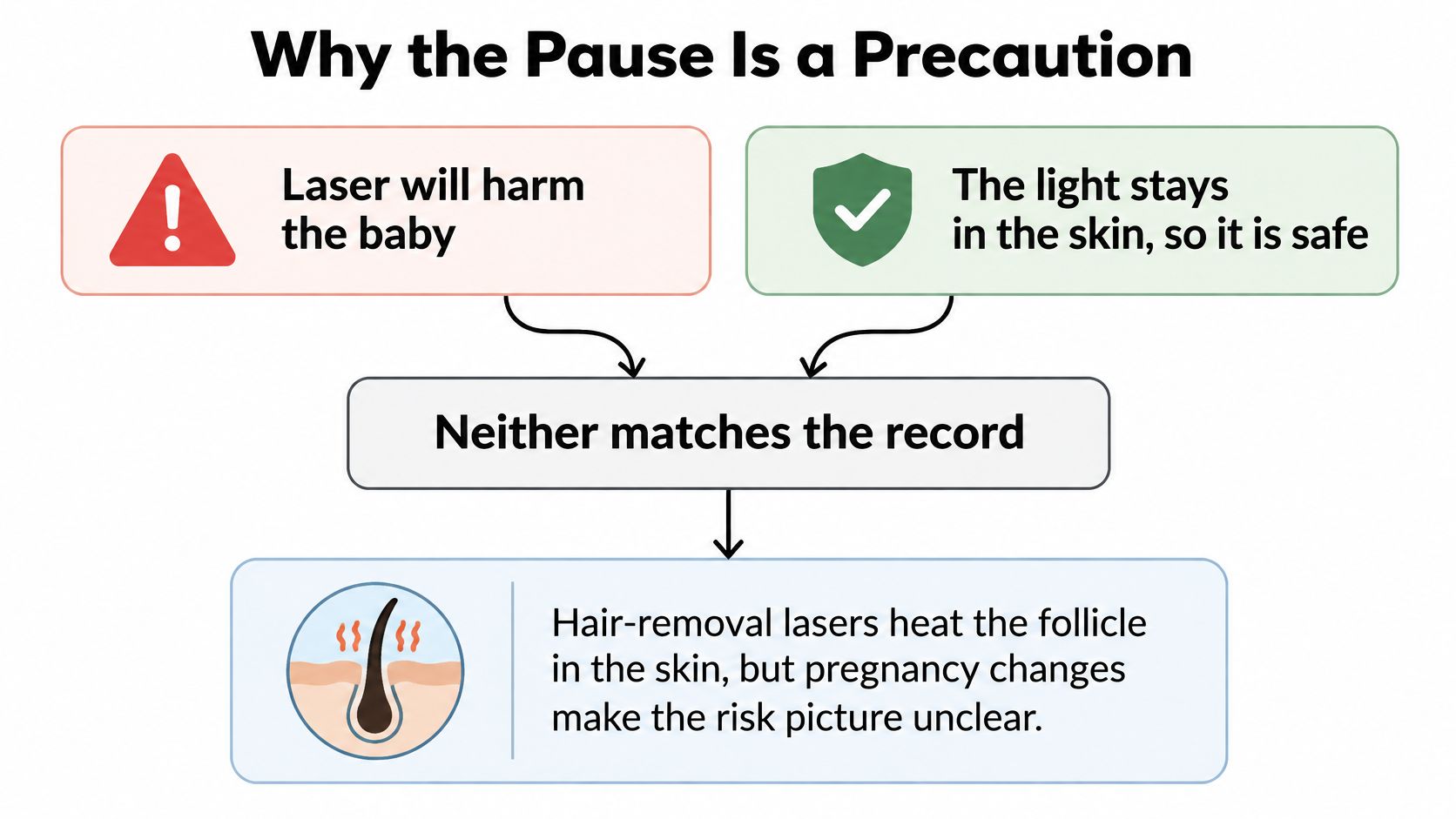
Two claims travel fast online. One says laser will harm the baby. The other says it is safe because the light stays in the skin. Neither matches the record.
Hair-removal lasers heat the follicle in the superficial skin, and that energy isn't expected to reach the fetus. A physical expectation still isn't a controlled study of an elective cosmetic treatment.
A review of laser procedures in pregnancy reported no clear adverse fetal outcomes among 380 treated women, mostly for medical rather than cosmetic reasons, while a systematic review found no pregnancy-specific safety data for hair-removal lasers. There isn't enough direct evidence to justify an elective procedure during pregnancy. I would not say lasers cause birth defects.
Known skin risks for any client include burns, colour change, scarring, eye injury, and paradoxical hair stimulation. Our Canadian guide to laser hair removal side effects covers those reactions. No reliable Ontario rate of pregnancy-related laser complications has been identified, and that gap matters.
Bring your own history to your doctor or midwife: medications, treatment area, skin tone, recent tanning, and any earlier sessions.
How Pregnancy Changes Hair and Skin
Many clients in London, Ontario notice a new moustache, a darker trail on the abdomen, or thicker bikini hair and assume it will stay. Pregnancy hormones can push more follicles into growth and make existing hair look coarser. A lot of that change settles in the months after birth, so treating it mid-pregnancy can mean chasing a short-lived pattern.
Laser only affects hairs in the active growth phase. A shifting hormone picture makes it harder to predict which hairs will respond, or how long a reduction will last. A public-health pregnancy resource notes that hormonal changes may reduce treatment effectiveness and that long-term results can be less predictable. Canadian guidance doesn't give a universal restart interval. It asks for medical advice in pregnancy or breastfeeding instead of a fixed wait. No Canada-wide count of who keeps pregnancy-related hair was found.
Pigment and a moving target
Skin can be more sensitive and more likely to darken, including melasma. A dose that felt fine before pregnancy may redden more easily, and colour change is a known laser risk where pigment is already active. Recent sun, self-tanner, and a deeper summer tan raise that risk further.
Laser needs a stable target. Pregnancy keeps moving both the hair cycle and the skin's pigment. Wait, protect skin from sun, and reassess once hormones and colour have settled. Some people also look at holistic pregnancy guidance for Houston women while they sort comfort and care with their own clinician. Hair that isn't driven by pregnancy has different causes, which our note on reasons for unwanted hair growth separates from a temporary hormone shift. Ask your doctor or midwife before any clinic device is used on pigment or hair.
Gentler Ways to Manage Hair for Now
While laser waits, hair still needs managing. Shaving and trimming are the simplest temporary options. Neither changes the follicle, so there is no laser-style reduction. That is the point during pregnancy.
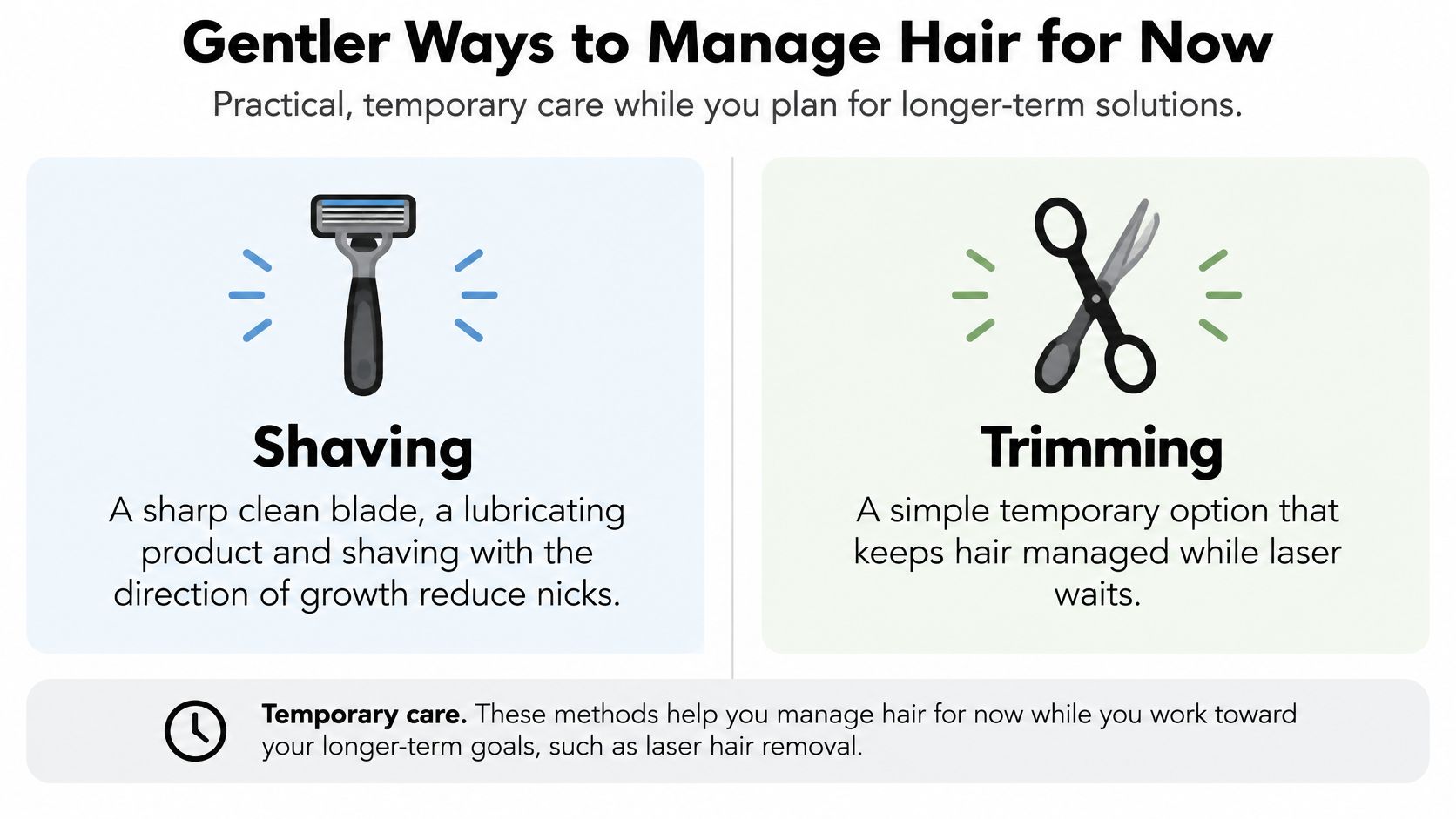
Shaving: Use a sharp clean blade, a lubricating product, and stroke with the direction of growth. That combination cuts down nicks on skin that may already be more reactive.
Trimming: Small scissors or a guarded trimmer suit the bikini line and facial hair you only want shorter. You aren't trying to clear the skin.
Creams and pulling methods
Depilatory creams use chemicals to dissolve the hair shaft. Check any cream with your doctor or midwife first, read the label, and patch-test a small area. Pregnancy skin can sting or pigment more easily. Don't put a depilatory on broken skin.
Waxing and sugaring pull hair from the root and can leave pregnancy skin red, bumped, or marked, so they aren't the default here. If you want a plain comparison of how those methods differ from laser outside pregnancy, our laser and waxing guide for Canadian consumers is the place to start. People comparing home methods sometimes read body sugaring insights from Momotaro Apotheca before they decide what feels tolerable.
If a method causes rash, burning, or colour change, stop and ask your clinician.
None of these steps replaces medical advice, and none is an invitation to book a clinic treatment while you are pregnant. The goal is comfort until a laser plan is appropriate again.
What to Tell Your Provider First
A useful consultation starts with disclosure, not with a request to be squeezed onto the laser list.
Tell us if you are pregnant, think you might be, or are breastfeeding. Give the due date or how many weeks you are, the area you wanted treated, and any session you already had. Note changes in hair, itching, pigment, or sensitivity. List medications, recent tanning, and any advice your doctor or midwife has already given.
In our London clinic, we pause planned laser sessions and ask you to speak with your doctor or midwife before you decide when to resume. Limited evidence about cosmetic laser in pregnant clients doesn't prove harm, and it doesn't prove safety. Pregnancy can also change sensitivity, pigmentation, hair growth, and how skin responds. Skinsation Aesthetics lists laser hair removal in London with separate booking categories for Fitzpatrick skin types 1–3 and 4–6, and that page doesn't state that treatment is offered during pregnancy.
If you already bought a package, ask us about pausing your sessions. We can't promise that every expiry date or payment rule will be waived, so ask about your specific terms. Your doctor or midwife still gives the pregnancy-specific medical advice. Our role is to defer treatment when it isn't appropriate and to reassess once you are cleared.
When Laser Can Start Again After Birth
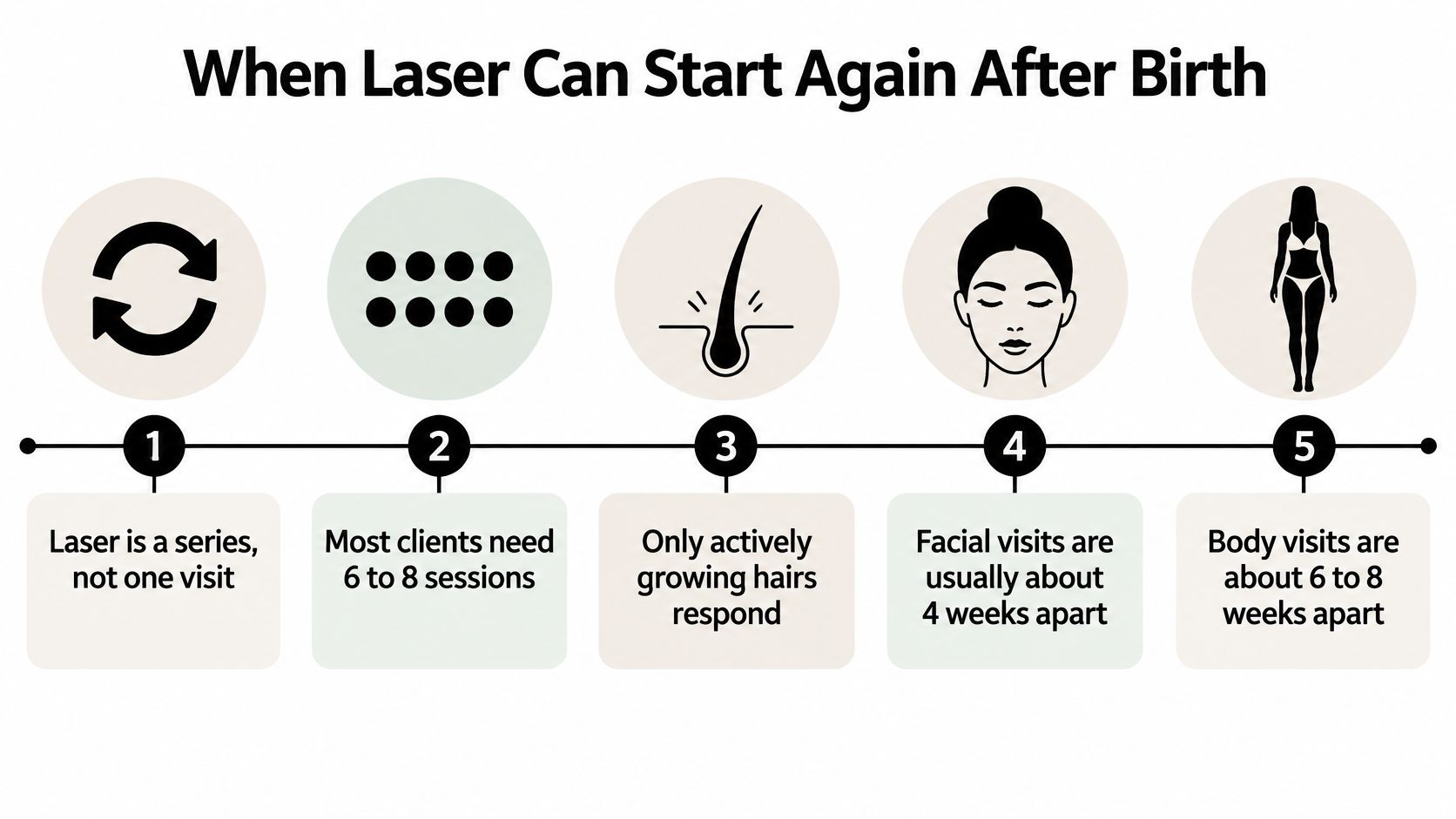
Laser is a series, not one visit. Skinsation Aesthetics states that most clients need 6 to 8 sessions, with facial treatments usually about 4 weeks apart and body treatments about 6 to 8 weeks apart, because the laser only treats hairs that are actively growing. Pausing in pregnancy shifts that whole calendar. It doesn't move one appointment by a few weeks.
Canadian guidance doesn't give a universal number of weeks after birth. I won't invent one.
Clearance first. Delivery has happened, and your doctor or midwife has cleared you.
Breastfeeding is its own question. If you are breastfeeding, ask that clinician specifically. It isn't an automatic yes.
A fresh skin check. We look again at hair growth, pigment, sensitivity, recent sun, and medications. A patch test or more conservative settings may be the right start.
The area you wanted treated at month six may look different once hormone-driven hair has thinned. Read how areas and session spacing work before you assume an old plan still fits. Bring your clearance to the visit. If skin is still unsettled, waiting longer is reasonable.
Questions to Settle Before You Book
Can you get laser hair removal while pregnant?
Our clinic doesn't book elective laser during pregnancy. The reason is limited research, not a finding of harm. Your doctor or midwife should hear the question too.
What if I had a session before I knew I was pregnant?
Tell your doctor or midwife straight away so they can advise on that exposure. Keep any further sessions on hold until they have spoken with you.
When can I start again after giving birth?
There is no single week count. Start with clearance from your doctor or midwife, then a fresh skin and hair assessment at a new consultation. Old settings shouldn't be reused on autopilot.
Is laser OK while breastfeeding?
Check with your doctor first. Breastfeeding means we won't assume treatment is fine. Once that clinician has advised you, we can look at whether a visit is suitable.
Laser hair removal is a service we offer for clients who are no longer in that precaution window and who have been cleared to proceed.
Skinsation Aesthetics Inc. offers laser hair removal in London for clients who have finished pregnancy precautions and have clearance from their own clinician. A post-pregnancy visit is a new look at your skin and hair, not an automatic restart of an old plan. Book that consultation by calling 519-933-8538 or visiting Skinsation Aesthetics Inc..
Comments