

Laser Treatment for Skin Tag Removal Guide

Laser treatment for skin tag removal is a game-changer. It's an incredibly precise and minimally invasive way to get rid of those annoying growths using focused light energy to simply vaporize them. The technique targets the stalk of the tag, removing it cleanly while sealing the blood vessel. The best part? This means minimal bleeding, scarring, or downtime. It's easy to see why it’s such a popular choice across Canada for its safety and beautiful cosmetic results.
Understanding Laser Treatment for Skin Tags
If you've ever found a small, soft bit of hanging skin on your neck, underarms, or even your eyelids, you've met a skin tag. Their official name is acrochordons, and these little benign growths are incredibly common. In fact, it's estimated that about half of all adults in Canada will get at least one skin tag in their lifetime.
While they're completely harmless, they can definitely be a nuisance. They get caught on clothing or snagged on jewellery, which can lead to irritation or even bleeding. For many people, especially when tags pop up in visible spots like the face or neck, the main concern is simply how they look. That's when having them professionally removed becomes a very appealing option.
Why Choose a Professional Solution
When you start looking into skin tag removal, the options can feel a bit overwhelming, from over-the-counter kits to clinical procedures. But trying to remove them yourself at home is risky—you could be dealing with infection, scarring, or not getting the whole thing, which just leads to it growing back.
This is where professional laser treatment for skin tag removal really shines. At Skinsation Aesthetics in London, Ontario, we specialize in advanced laser solutions that stand out as the superior choice for a few key reasons:
Precision: The laser energy is focused only on the skin tag, leaving the healthy skin around it completely untouched.
Safety: When a certified technician performs the procedure, it's controlled and safe, dramatically lowering the risk of any complications.
Minimal Scarring: Because the laser cauterizes the tissue as it works, the healing is clean and neat. This leads to fantastic cosmetic results with little to no scarring left behind.
Efficiency: The treatment is surprisingly quick. It often takes just a few minutes to deal with one or even several skin tags in a single visit.
At our clinic in London, Ontario, Skinsation Aesthetics uses the advanced Aerolase laser system for an even gentler experience. This technology provides a safe, effective, and comfortable solution for removing skin tags on all skin types, ensuring a smooth path to clearer skin.
How Laser Energy Safely Removes Skin Tags
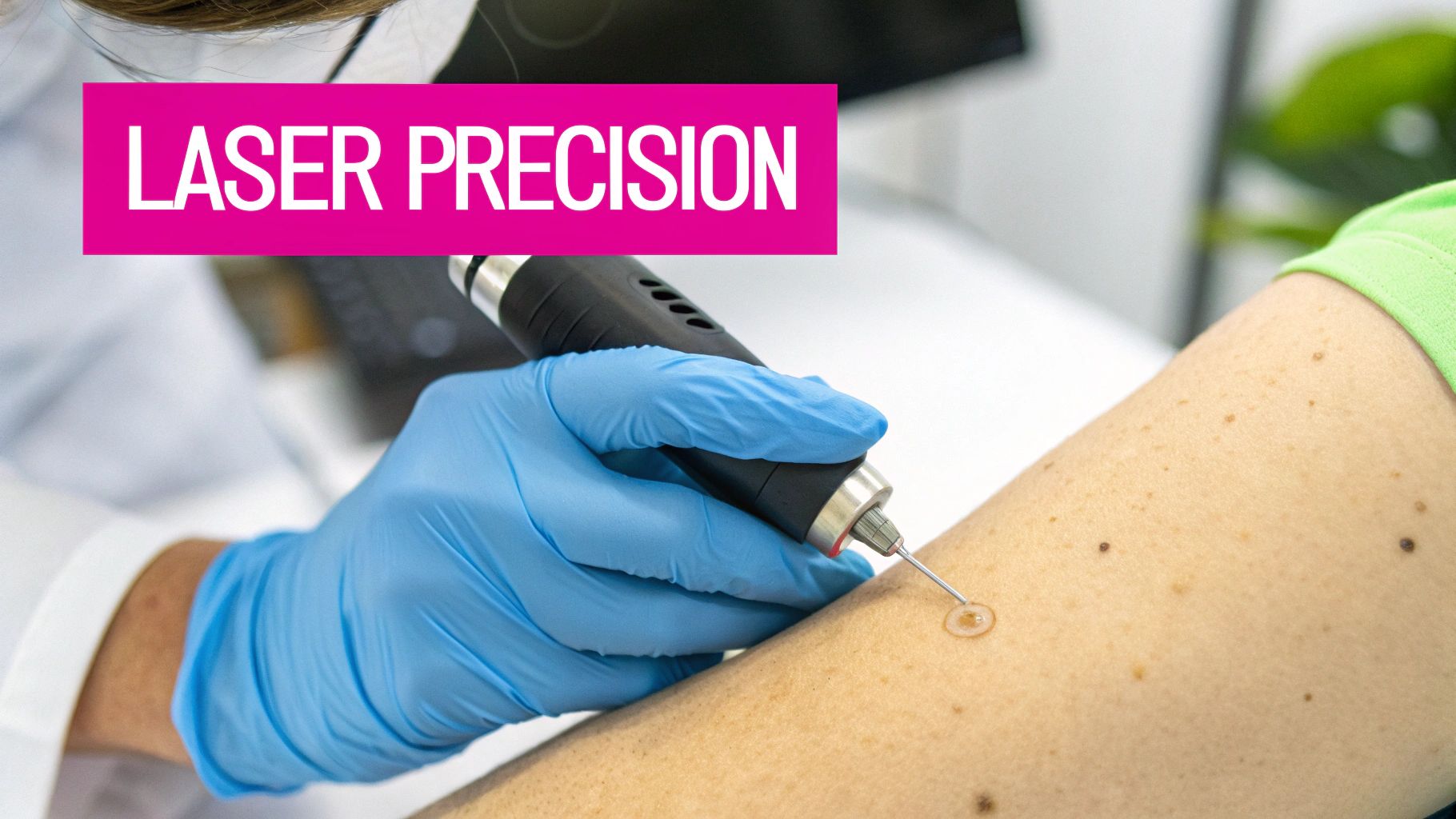
You don’t need a physics degree to understand how a laser deals with a skin tag. Just picture an incredibly smart and precise beam of light. This light energy is tuned to a very specific wavelength—one that gets soaked up by the pigment and tiny blood vessels inside the skin tag, but is completely ignored by the healthy skin around it.
That targeted approach is really the secret to its safety and success. The laser is aimed right at the little stalk (the peduncle) that connects the skin tag to your body. As that tissue absorbs the focused energy, it heats up in just a fraction of a second.
This flash of heat does two critical things at once: it vaporizes the unwanted cells that make up the tag and instantly cauterizes (or seals) the tiny blood vessel that was feeding it. That means there's virtually no bleeding, which makes the whole treatment incredibly clean, fast, and efficient. Because the surrounding skin is left untouched, the risk of scarring is dramatically lower compared to more traditional methods.
The Aerolase Neo Elite Advantage
Here at Skinsation Aesthetics in London, Ontario, we don't just use any old laser. We trust the Aerolase Neo Elite, a real standout in aesthetic technology. So, what makes it so special? It all comes down to its unique 650-microsecond pulse duration. That might sound technical, but the idea behind it is quite simple.
Think about touching a hot stove. If you hold your finger there for a full second, you’re going to get a nasty burn. But if you tap it super quickly—so fast you barely make contact—you can pull away without any pain or damage. The Aerolase laser works on a similar principle.
It delivers its energy in a pulse that's unbelievably short (less than a thousandth of a second!), so the heat doesn't have time to spread to the surrounding skin and cause discomfort. This allows the energy to pass safely through the top layer of your skin (the epidermis) to precisely hit the structures of the skin tag underneath.
This unique mechanism brings some major benefits to the table for laser treatment for skin tag removal:
Safety for All Skin Tones: Older lasers sometimes posed a risk for darker skin tones because of their higher melanin content. The Aerolase’s rapid-fire pulse completely sidesteps that issue, making it a safe bet for virtually every client here in Canada.
Minimal Discomfort: Most people describe the feeling as a mild, warm sensation. There's no lingering heat or burning, making the procedure comfortable enough that topical numbing creams often aren't needed.
No Downtime: Since the surrounding tissue isn't affected, there’s no real recovery period. You can head right back to your daily routine as soon as you leave your appointment.
The Science of Targeted Energy Delivery
The technology powering the Aerolase gives us a level of precision that was once hard to imagine. The laser energy is naturally drawn to melanin (the pigment) and hemoglobin (found in blood), both of which are packed into the skin tag's structure but are less concentrated in the healthy tissue nearby.
By delivering energy faster than the skin's thermal relaxation time—that's the time it takes for skin to cool itself down—the Aerolase laser effectively destroys the skin tag's structure without any collateral damage. This is the cornerstone of its safety and a primary reason we trust it for delicate areas.
This precision is a game-changer, especially for skin tags in highly visible or sensitive spots like the face, eyelids, or neck. You can learn more about how the Aerolase laser works for various skin concerns beyond just tags by checking out our other resources.
Ultimately, the process is clean and perfectly controlled. The laser energy is absorbed, the skin tag tissue is vaporized, and the blood vessel is sealed off. The treated tag might vanish right away, or it might form a tiny, dry crust that falls off on its own within a few days, revealing smooth, clear skin underneath. It’s this scientific elegance that makes laser removal the preferred modern solution.
Comparing Your Skin Tag Removal Options
So, you've decided it's time to say goodbye to a bothersome skin tag. Great! But now you're faced with a few different professional options. The choice can feel a bit overwhelming, but once you understand the key differences in precision, recovery, and the final look, the decision gets a lot clearer.
For most of us here in Canada, especially when dealing with tags on visible spots like the face and neck, laser treatment for skin tag removal consistently comes out on top. Why? It delivers an elegant, scar-free finish that other methods just can't match.
Of course, lasers aren't the only game in town. Other common in-clinic procedures include cryotherapy (freezing it off) and surgical excision (cutting it off). Each one works, absolutely, but they all offer a very different experience from start to finish.
Let's break down how these methods really stack up against each other.
Laser Removal vs. Cryotherapy and Excision
To make a choice you feel confident about, it helps to see a side-by-side comparison. Every method has its place, but the right one for you really depends on your personal priorities. Are you focused on minimizing discomfort? Avoiding a scar at all costs? Getting back to your routine immediately?
This table lays out the crucial factors for each of the three main professional skin tag removal methods to help you see the full picture.
Comparison of Skin Tag Removal Techniques
Here's a detailed comparison of common skin tag removal methods, evaluating them on key factors to help you make an informed decision.
Method | Procedure | Pain Level | Recovery Time | Risk of Scarring | Best For |
|---|---|---|---|---|---|
Laser Removal (Aerolase) | A focused beam of light instantly vaporizes the skin tag while sealing the blood vessel. It's incredibly precise and doesn't even touch the skin. | Minimal. Most people say it feels like a tiny, warm snap. We rarely even need numbing cream at our clinic. | Almost none. You might see a little redness, but it usually fades within a few hours. | Very Low. The laser's precision protects all the surrounding skin, which is the key to clean, seamless healing. | Visible or sensitive areas like the face, eyelids, and neck; anyone wanting the best possible cosmetic outcome. |
Cryotherapy (Freezing) | Liquid nitrogen is dabbed onto the skin tag. This freezes the tissue, causing it to fall off after about a week or two. | Moderate. A stinging or burning feeling is pretty common, both during the treatment and for a while after. | 1-2 weeks. A small blister often forms, which then scabs over before the tag finally falls off. | Moderate. This method can sometimes cause pigmentation changes (light or dark spots) that may be temporary or permanent. | Smaller tags on non-facial areas, where a minor change in skin colour or texture isn't a major concern. |
Surgical Excision (Cutting) | After a local anesthetic injection, the skin tag is snipped off with sterile surgical scissors or a scalpel. | Low during the procedure itself (thanks to the freezing), but you can expect some soreness afterward as it heals. | 1-2 weeks. This is a small wound that needs proper care, usually with a small bandage for a few days. | Moderate to High. This method always leaves a small scar, though it might fade over time. | Large, stalk-like (pedunculated) skin tags that might not respond as well to other methods. |
After looking at the table, it's pretty clear what the standout benefit of laser treatment is.
Why Precision Matters Most
When you break it all down, the single biggest advantage of laser treatment is its incredible precision. Think of it like trying to colour in a tiny circle with a fine-tipped pen versus a thick marker. Both cryotherapy and excision inevitably affect a small patch of healthy skin around the tag—and that's what leads to the higher risk of scarring or discolouration.
Laser energy, especially from an advanced system like the Aerolase, is delivered only to the skin tag tissue. It doesn’t spread or damage the adjacent healthy skin, and that’s the secret to getting such a clean, seamless result with pretty much zero downtime.
This level of control is absolutely critical for delicate areas. If you have a skin tag on your eyelid or along your neckline, avoiding even a tiny scar is probably at the top of your list. The technology behind cosmetic lasers is different from other light-based therapies, but the core principle of using targeted energy for precise results is well-established. If you're curious about how different light technologies work, you can check out our detailed comparison of IPL vs laser hair removal to get a better sense of how specific wavelengths are used to achieve different goals.
Ultimately, while freezing and cutting are perfectly good medical procedures, they just don't offer the same cosmetic finesse that laser removal does. For anyone looking for a result that is quick, comfortable, and looks fantastic, the choice becomes obvious. The goal isn't just to get rid of the tag; it's to leave the skin looking like the tag was never even there—and that's where laser technology truly shines.
Your Laser Removal Procedure Step by Step
Walking into a clinic for any procedure can feel a little intimidating, especially if it’s your first time. We get it. Knowing exactly what to expect helps melt away any uncertainty, turning apprehension into confidence. So, let's walk through the entire journey for a laser treatment for skin tag removal, from the moment you book your appointment to the second you leave with smoother skin.
At Skinsation Aesthetics in London, Ontario, the entire process is designed to be comfortable, professional, and completely transparent. Every step is about you—your safety, your comfort, and making sure you feel informed and at ease.
The Initial Consultation
Your journey doesn't start with a laser, but with a simple conversation. This initial consultation is probably the most important part of the process. A certified technician will sit down with you to:
Assess the Area: They’ll take a close look at the skin tags you want to address, noting their size, number, and location. This is also where they make sure the growths are definitely benign skin tags and perfect candidates for laser treatment.
Discuss Your Goals: This is your time. You can explain exactly what you're hoping to achieve and ask all your questions. A great technician will listen and give you clear, honest answers.
Create a Treatment Plan: Based on their assessment, they'll map out the best course of action. They’ll explain how the procedure works, the technology they use (like our gentle Aerolase laser), and the kind of results you can look forward to.
Review Your Medical History: They'll ask about any relevant health conditions or medications to ensure the procedure is perfectly safe for you.
This first meeting is all about building trust and making sure you're completely comfortable and a great candidate for the treatment.
Preparing for Your Appointment
One of the best things about modern laser skin tag removal is how little you have to do to prepare. It’s a straightforward, non-invasive procedure, plain and simple.
Generally, the only advice is to arrive with the treatment area clean and free of any lotions, creams, or makeup. If you have a skin tag in a particularly sensitive spot, the technician might apply a topical numbing cream about 20-30 minutes before starting, just to guarantee your comfort. Honestly, though, with the Aerolase technology we use, most clients find it’s not even necessary.
During the Laser Treatment
This is the part that’s often over in just a few minutes. Once you're settled in comfortably, the technician will prepare the area and give you some protective eyewear.
The laser handpiece is then positioned just above the skin tag—it never actually touches your skin. As the technician activates the laser, you might hear a soft sound and feel a quick, warm snapping sensation. Most people compare it to a tiny rubber band snap. It’s very brief and easy to handle.
The laser’s energy is delivered in incredibly short pulses, targeting the stalk of the skin tag with pinpoint accuracy. This focused energy instantly vaporizes the tissue and seals the tiny blood vessel that feeds it, all without harming any of the healthy surrounding skin.
The technician works methodically, treating each targeted skin tag one by one. Even if you have several tags to get rid of, the whole process is remarkably quick and efficient.
Immediately After the Procedure
As soon as that last pulse is delivered, you're done. The technician will apply a soothing ointment or protective cream to the treated spots. That's it!
You might see a little bit of redness around the area, kind of like a mild sunburn, but this usually fades within a few hours. The skin tag itself will either be gone completely or will have turned into a small, dark, dry speck. This tiny crust will fall off on its own in a few days, revealing clear, smooth skin underneath.
There’s no downtime required, which means you can walk right out of our London clinic and get back to your day. This infographic gives a great visual comparison of how laser stacks up against other common methods.
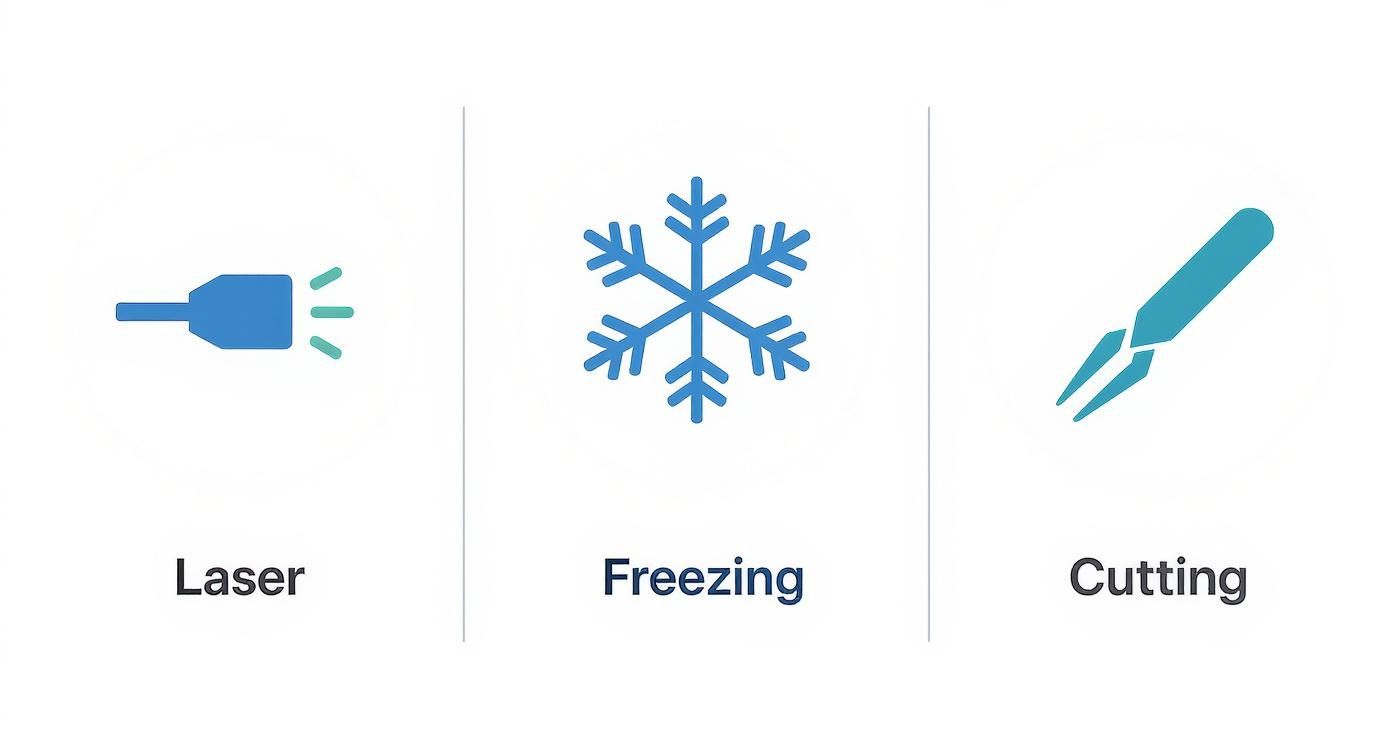
As you can see, laser treatment really shines when it comes to precision and minimal recovery time—a direct result of a careful process that keeps surrounding tissue completely safe.
What to Expect During Recovery and Aftercare
Getting your laser treatment done is a huge win, but the journey to perfectly clear skin doesn’t stop there. The next step—aftercare—is where you really lock in those beautiful results. Luckily, with advanced tech like the Aerolase laser we use at Skinsation Aesthetics, the recovery is surprisingly quick and straightforward.
Unlike more intense removal methods that leave you with bandages and a long healing period, our laser is incredibly precise, leaving the surrounding skin completely untouched. This means you have pretty much zero downtime. Most people just see a bit of localized redness, almost like a faint sunburn, that usually vanishes within a few hours.
The treated skin tag will form a tiny, dark crust over the next day or so. Don't panic! This is a totally normal and healthy part of the healing process. The most important thing you can do is let this little scab fall off on its own, which typically happens within 3 to 7 days. Whatever you do, resist the urge to pick or scrub at it. Patience is key to preventing any scarring and getting the best possible look.
Your Essential Aftercare Checklist
Following the personalized instructions from your technician is absolutely non-negotiable for a smooth recovery. The steps are simple, but they make all the difference. Think of it as protecting your investment in your skin.
Your main goals are simple: keep the area clean and protected.
Gentle Cleansing: For the first 24-48 hours, be extra gentle. Wash the area with a mild, non-abrasive soap and lukewarm water, then pat it dry with a soft towel. Avoid any harsh scrubbing or exfoliants until the spot is fully healed.
Moisturize and Soothe: A thin layer of a recommended soothing ointment, like Aquaphor or a simple antibiotic cream, can work wonders. It keeps the skin hydrated and creates a protective barrier while it heals. Your technician at Skinsation Aesthetics will point you to the perfect products.
Avoid Irritants: For a couple of days after your treatment, it's best to skip the swimming pool, hot tub, and sauna. The chlorine and intense heat can easily irritate the sensitive, healing skin.
The Importance of Sun Protection
This right here is the golden rule of any laser treatment aftercare. Seriously. That fresh, new skin is incredibly sensitive to ultraviolet (UV) rays. If you expose it to the sun without protection, you risk developing hyperpigmentation—dark spots that can be even more of a headache to deal with than the original skin tag.
Protecting your skin from the sun isn't just a friendly suggestion; it's the single most important step in your aftercare routine. Consistent sun protection ensures your skin heals evenly, preserving the fantastic results of your laser treatment.
For at least four weeks after your procedure, make sun protection your absolute priority. That means applying a broad-spectrum sunscreen with an SPF of 30 or higher every single day. Yes, even on those cloudy Canadian winter days! If the treated area is on your face or neck, a wide-brimmed hat is a great way to add an extra layer of defence.
By sticking to these easy steps, you're setting yourself up for a quick, complication-free recovery and the smooth, clear skin you've been waiting for.
Understanding Skin Tag Removal Costs in Canada
Let’s talk about one of the most practical questions on everyone's mind: what’s the investment? When you’re considering professional laser treatment for skin tag removal, it’s smart to get a clear picture of the costs involved, especially here in Canada. This way, you can budget properly and really understand the value that comes with a safe, expert-led procedure.
The first thing to know is that skin tag removal is almost always considered a cosmetic treatment. This means it isn't covered by provincial health plans like the Ontario Health Insurance Plan (OHIP). It's an out-of-pocket expense, just like other aesthetic services you might invest in.
Factors That Shape the Final Price
The cost for laser skin tag removal isn't a simple, one-size-fits-all number. A few key factors come into play to determine the final price for your treatment, making sure you’re only paying for exactly what you need.
The biggest influences on your quote will be:
The Number of Skin Tags: This is the main driver of the cost. Naturally, treating one or two tags will be less of an investment than clearing away ten or more.
Size and Complexity: Larger or more stubborn skin tags might need a bit more time and laser energy to be fully removed, which can nudge the price up.
Location on the Body: Skin tags hanging out in delicate or tricky spots, like near the eyelids, demand more precision and care. That extra time and skill can sometimes affect the overall cost.
How Clinics Typically Price Their Services
In London, Ontario, and right across the country, you'll find that clinics generally use one of two pricing models for this service. Some will charge on a per-tag basis, which is really straightforward if you just have a few you want gone. You might see a set price for the first one, with each additional tag costing a little less.
The other popular route, which we often use here at Skinsation Aesthetics, is offering package pricing or tiered rates. This is a fantastic option if you have multiple skin tags. It usually provides much better value because the cost-per-tag drops as the total number you’re treating goes up. For anyone looking to clear a whole area, this is usually the most cost-effective way to go.
While prices will vary from one clinic to another, you can generally expect the cost to start somewhere around $75 to $150 for a single skin tag in Canada. If you have multiple tags, packages might land in the $200 to $500 range, or more, depending on the final count and complexity.
The absolute best way to know for sure is to book a consultation. It gives a technician the chance to take a look, understand your specific goals, and give you a completely transparent breakdown of what it will take to get that clear, smooth skin you’re looking for.
Your Questions About Laser Skin Tag Removal, Answered
Even after getting the full picture, it’s completely normal to have a few questions lingering. You’re making a decision about your skin, after all, and feeling confident in your choice is what matters most. I’ve put together this final section to tackle the most common questions we hear from our clients right here in Canada.
Think of this as your quick-fire guide to clear up any last bit of uncertainty. We’ll cover everything from the sensation of the treatment to the chances of regrowth, so you can feel totally prepared.
Is Laser Skin Tag Removal Painful?
This is almost always the first thing people ask, and I'm happy to say the answer is a relief for most. Clients usually describe the feeling as a tiny, super-fast snap against the skin—like a small rubber band. It’s over in an instant and very easy to tolerate.
The discomfort is really minimal and brief. We use an advanced Aerolase system at our London, Ontario clinic, which is known for being especially gentle. Its unique 650-microsecond pulse technology is so quick that it zaps the tag without heating up the surrounding skin, making the whole experience remarkably comfortable. For those extra-sensitive spots, we can always apply a topical numbing cream beforehand so you barely feel a thing.
How Many Laser Sessions Will I Need?
Here’s more great news: for the vast majority of our clients, only one session is needed to say goodbye to a skin tag for good. The laser is incredibly precise and efficient, vaporizing the tag and sealing off its blood supply in one quick, effective treatment.
And if you have a few skin tags you want gone? We can almost always treat all of them in the same appointment. This makes laser removal not just effective but also incredibly convenient. You get immediate results without having to book multiple visits.
Will My Skin Tags Grow Back After Laser Treatment?
Once we’ve removed a specific skin tag with the laser, that particular one is gone forever. It will not grow back in the same spot because the entire growth is permanently and effectively eliminated.
It's important, though, to know the difference between regrowth and new growth. The laser treats the skin tags you have now, but it can’t prevent new ones from popping up in the future. If you’re prone to developing skin tags due to genetics or friction in certain areas, you might see new ones appear over time. The good news is, we can treat those just as easily.
A professional laser procedure ensures the entire skin tag, right down to its base, is removed. This complete removal is the key to preventing that same tag from ever coming back—a common frustration with less precise at-home methods.
Is This Procedure Safe for Sensitive Areas?
Absolutely. In fact, the laser’s incredible precision is exactly why it’s considered the best choice for delicate or highly visible spots. Think about places like the eyelids, neck, underarms, or groin—you need a treatment that’s both gentle and pinpoint accurate.
The laser energy is focused only on the skin tag, leaving your healthy surrounding skin completely untouched. This avoids any risk of collateral damage, which is a big advantage over methods like freezing or cutting that can affect a wider area. This level of control makes laser treatment for skin tag removal the safest and most elegant option for those tricky spots where you want a flawless result.
Ready to enjoy the clear, smooth skin you deserve? The team at Skinsation Aesthetics is here to answer any other questions you have and guide you through a comfortable and effective treatment. Book your consultation with us in London, Ontario today to get started.
Comments