

How to Get Rid of Smile Lines: A London Ontario Guide

Most advice about how to get rid of smile lines starts with the wrong assumption: that every crease around the mouth is merely a wrinkle waiting to be erased. That approach leads people towards unsuitable creams, excessive filler, or treatments that improve skin texture while leaving the underlying fold unchanged.
Smile lines need a proper assessment first. Some are structural nasolabial folds created by midface volume loss, while others are finer expression creases that appear with smiling, talking, and repeated movement. The right plan depends on which problem you're trying to correct.
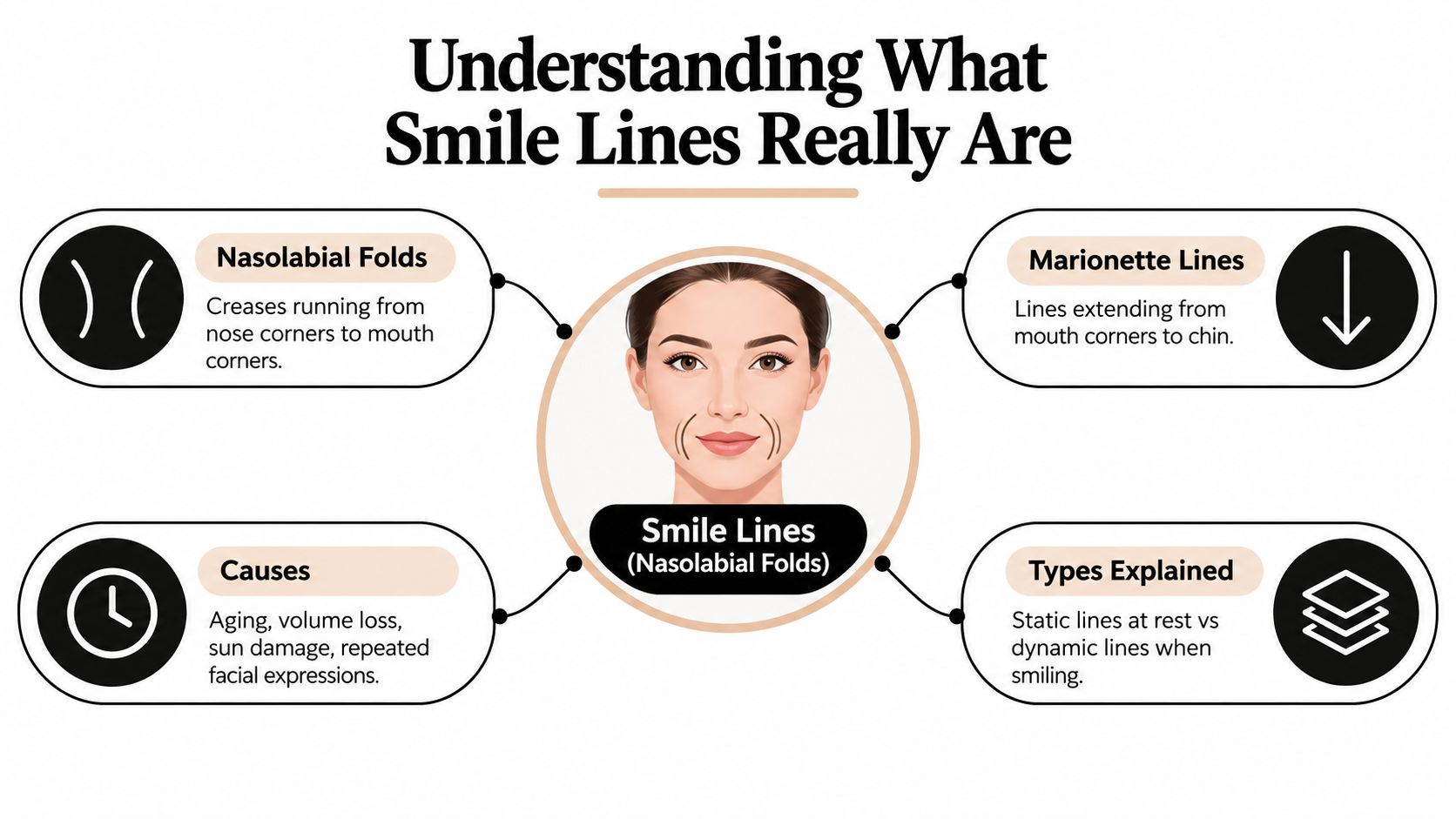
Understanding What Smile Lines Really Are
Smile lines, clinically known as nasolabial folds, are creases that run from the sides of the nose towards the corners of the mouth. They're a normal part of facial anatomy, but they may become more visible and permanent over time. Canadian consumer health guidance also identifies sun exposure and smoking as factors that can worsen their appearance. Learn more about the causes of nasolabial folds from NIVEA Canada.
The important distinction is between a static fold and a dynamic expression line. A static fold remains visible when your face is relaxed. It often reflects changes in the midface, including volume loss, reduced elasticity, skin thinning, and the gradual descent of tissue around the cheeks. A dynamic line becomes more pronounced when you smile or speak and may be linked more closely to repetitive muscle movement and the way your skin folds during expression.
Volume loss versus expression lines
A cream can improve dryness and surface texture, but it can't replace lost cheek support. Conversely, treating every line with volume can produce an unnecessarily heavy result when the primary concern is thin, crepey skin or an active crease.
This distinction matters in London, Ontario, where facial-aging concerns are not a niche issue. A Canadian release discussing approval of next-generation facial fillers reported that one in five Canadian women is bothered by smile lines, increasing to one in four women in their 50s. The same release reported that 60% of women were somewhat to extremely bothered by lines, wrinkles, or folds in the mid-face around the cheeks and mouth. Read the Canadian reporting on smile-line concerns and facial fillers.
Practical rule: Treat the cause, not just the visible crease.
Marionette lines are different again. They extend downwards from the corners of the mouth towards the chin, while nasolabial folds begin beside the nose. The two concerns can appear together, but they don't automatically require the same placement, product, or treatment strategy.
A consultation should assess your face at rest and during expression, the depth and direction of the fold, cheek support, skin quality, asymmetry, and your tolerance for downtime. That assessment is more useful than choosing a treatment because it is marketed broadly for “wrinkles.”
Effective At-Home Skincare Strategies
Home care is valuable, but it has a defined role. It can improve hydration, texture, and the appearance of fine surface lines. It won't reliably recreate lost midface volume or remove a deep fold that remains visible when your face is relaxed.
A practical routine should be consistent rather than crowded with products. Start with a gentle cleanser, then use targeted ingredients according to your skin's tolerance and the advice of a qualified skincare professional.
Build the routine in stages
Protect the skin every morning. Apply a broad-spectrum sunscreen daily and reapply when exposure is prolonged. UV exposure contributes to collagen breakdown and can make existing lines more noticeable, so prevention is more effective than trying to repair repeated sun damage later.
Support hydration. A moisturiser containing hyaluronic acid can make dehydrated skin look temporarily fuller and smoother. It doesn't act like an injectable filler, but well-hydrated skin reflects light more evenly and usually shows fewer fine surface creases.
Introduce a retinoid carefully. Retinol or another suitable retinoid can support cell renewal and improve the look of fine lines over time. Begin gradually, use a small amount at night, and avoid applying too close to the corners of the mouth if that area becomes irritated. Peptides can also complement a routine focused on elasticity and skin conditioning.
Add antioxidant support if appropriate. A morning antioxidant product, such as a vitamin C formula, may help support a broader approach to environmental protection. Choose a formulation your skin can tolerate rather than combining several strong products at once.
Keep the barrier comfortable. Flaking and irritation can make lines look deeper. If your skin becomes tight, sore, or persistently red, reduce active ingredients and prioritise moisturisation until the barrier settles.
For ingredient selection and routine planning, the Skinsation guide to anti-ageing ingredients offers a useful starting point. A skincare routine should support professional treatment, not create inflammation before it.
Massage and expectations
Some people use gentle facial massage to temporarily soften the look of lines or relieve a sense of tightness. A Canadian skincare source describes repeating a knuckle massage about 20 times per side daily, along with facial exercises held for 15 to 20 seconds or 2 to 3 seconds, depending on the movement. See the Canadian guidance on massage and facial exercises for nasolabial folds.
Massage shouldn't be sold as a replacement for structural correction. It may change circulation, fluid distribution, or the way the skin looks briefly, but it won't restore cheek volume. The same Canadian source states that completely getting rid of smile lines without potentially costly or invasive treatment isn't realistic, although topical creams, massage, and light therapy may reduce their appearance.
Give home care enough time to judge it fairly. Hydration can improve the surface look quickly, while retinoid-based changes and improved texture require sustained use. If a fold is deep at rest, skincare is best viewed as maintenance and preparation rather than the complete solution.
Professional Clinical Treatment Options
Professional treatment is not automatically the right answer for every smile line. The first decision is whether the line reflects lost support in the cheek and midface, repeated facial movement, or a change in skin texture. A volume-loss nasolabial fold and an expression-line crease require different treatment plans, even when they appear in the same area.

Hyaluronic-acid filler for structural folds
Hyaluronic-acid filler is most appropriate when a nasolabial fold is primarily caused by volume loss. The product is placed beneath the skin to restore support and soften the depression, rather than treating only the surface. Health Canada-approved JUVÉDERM fillers are indicated in Canada for temporary volume correction in areas including the cheeks and smile lines, while JUVÉDERM VOLIFT is described for nasolabial folds. Review the Canadian treatment information for JUVÉDERM smile-line filler.
The IDC Cosmetic Clinic treatment guide states that a session may use 2 to 4 mL, depending on the degree of volume loss, with results typically lasting 12 to 24 months. Explore this Canadian guide to a non-surgical nasolabial fold solution. Explore this non-surgical nasolabial fold solution guide from Ideal Face and Body. These figures describe a possible treatment range, not a promise for every face. Product choice, placement, metabolism, anatomy, and the need for cheek support all affect the plan.
A conservative result should soften the fold while preserving facial movement and proportion. A prospective crossover study of 152 adults assessed staged hyaluronic-acid treatment at weeks 2, 4, 6, 8, 12, and 24, with 92% to 100% of subjects showing at least some improvement at each visit. Subjects reported looking 3 to 6 years younger, and combining botulinum toxin with hyaluronic acid produced clinically meaningful gains regardless of treatment order. Read the clinical study on staged nasolabial-fold treatment.
Microneedling for skin quality
Microneedling creates controlled micro-injuries that stimulate collagen remodelling. It suits fine lines, early creasing, uneven texture, and reduced elasticity better than a pronounced fold caused mainly by missing volume. It may also be considered when the line is visible during expression but the underlying cheek structure remains adequate.
A single-centre trial of 35 adults used four monthly facial microneedling sessions and found statistically significant wrinkle improvement 30 days after the series, with benefits lasting at least 90 days after the final treatment. At three months, the study reported facial dermal density increasing 101.86%, epidermal density increasing 19.28%, and facial elasticity increasing 28.2% from baseline. Review the microneedling wrinkle study.
The trade-off is gradual improvement. Microneedling can make surrounding skin look firmer and more refined, but it does not replace cheek volume in the way filler can.
Resurfacing and tightening options
Laser resurfacing and skin-tightening treatments address texture, pigmentation, fine lines, and laxity rather than directly filling a deep nasolabial fold. Chemical peels may improve surface smoothness when dullness, uneven tone, or fine creasing contributes to an aged appearance.
A newer dual-wavelength Clear + Brilliant Touch platform received Health Canada approval and began being offered by Canadian physicians in 2025 for wrinkles, pigmentation, skin texture, and pore size, supported by more than 15 clinical studies. Read the Canadian market announcement about Clear + Brilliant Touch. It is better suited to incremental, maintenance-focused skin improvement than to one-step correction of established nasolabial folds.
For an overview of a non-invasive tightening approach in London, Ontario, read this guide to Xerf skin tightening. A plan may combine structural correction with resurfacing when both volume loss and poor skin quality are present. The combination should be deliberate, because adding procedures does not automatically produce a more natural result.
Cost, Timeline, and Expected Results
A responsible treatment plan starts with transparent expectations, even when a clinic can only provide an exact price after assessment. Costs vary according to the procedure, product, provider expertise, treatment area, and the amount of correction required. Filler is commonly priced according to product used, while microneedling, peels, and laser treatments may be priced as individual appointments or organised into a course.
What the timeline looks like
Hyaluronic-acid filler generally provides visible correction promptly, although swelling and tenderness can temporarily obscure the final result. A conservative provider will reassess rather than add product immediately. The clinical study cited earlier followed participants through week 24, which reinforces why early appearance shouldn't be treated as the finished outcome.
Microneedling works through delayed collagen remodelling. In the clinical trial, the protocol involved four monthly sessions, and wrinkle improvement was assessed after the series rather than after one isolated appointment. Use this London, Ontario microneedling guide to understand treatment cost, results, and session planning.
Resurfacing and tightening treatments usually require a personalised schedule based on energy level, skin type, pigmentation risk, downtime tolerance, and the degree of laxity. A gentler treatment may be easier to maintain but less dramatic, while a stronger resurfacing approach may improve texture more noticeably and require more recovery.
What you're paying for
The lowest quoted price isn't necessarily the lowest total investment. A treatment that doesn't address the cause may leave you paying for repeated surface procedures while the structural fold remains. Equally, choosing a stronger intervention than necessary can create avoidable downtime and expense.
Concern | Treatment direction | Main trade-off |
|---|---|---|
Deep fold visible at rest | Conservative hyaluronic-acid filler assessment | Faster correction, temporary maintenance required |
Fine lines and thin texture | Microneedling or resurfacing | Gradual improvement, multiple visits may be appropriate |
Early ageing and uneven skin quality | Gentle resurfacing or tightening | Subtle results, ongoing maintenance matters |
Dry, crepey surface | Home skincare and barrier support | Improves appearance, doesn't restore lost volume |
Longevity is individual. Canadian clinic education describes hyaluronic-acid filler results as typically lasting 12 to 24 months, but maintenance shouldn't be scheduled automatically without reviewing how your face has changed. A natural result often comes from reassessment and modest adjustments, not from treating the calendar.
Investment advice: Ask what problem the treatment is correcting, when the result will be assessed, and what maintenance would look like before you commit.
Choosing the Right Path for You
The most useful answer to “how to get rid of smile lines” is rarely a single product name. It's a decision process that separates skin quality, dynamic movement, and structural volume loss.
Start by looking at the fold in neutral expression. If it almost disappears when your face is relaxed and appears mainly as you smile, begin with prevention, hydration, sun protection, and an assessment of facial movement. If it remains strongly visible at rest, ask whether midface support and volume loss are contributing. If the line is shallow but the surrounding skin looks thin, rough, or uneven, a collagen-stimulating or resurfacing plan may be more appropriate than filler alone.
Match the treatment to the problem
A simple decision framework can prevent over-treatment:
Choose home care first when the concern is mild dryness, early fine lines, or inconsistent texture. Use sunscreen, moisturiser, carefully introduced retinoid products, and supportive ingredients such as hyaluronic acid and peptides.
Consider microneedling when you want gradual improvement in elasticity and texture without injectable volume. The evidence supports a disciplined series, not an isolated appointment followed by disappointment.
Discuss hyaluronic-acid filler when the fold is deep at rest and the assessment identifies volume loss as a major factor. The purpose is support and softening, not complete erasure.
Discuss resurfacing or tightening when pigmentation, roughness, pores, fine lines, or mild laxity are the dominant concerns. These treatments can improve the canvas, but they aren't substitutes for structural correction.
Consider combination care when more than one factor is present. A person may need volume support for a deep fold and separate treatment for crepey texture. The treatments should be sequenced around healing, risk, and the desired degree of change.
London, Ontario residents should also consider the provider's assessment process. Ask whether the practitioner examines the full midface rather than injecting directly into the deepest point, explains temporary versus progressive results, and sets out what happens if asymmetry remains. For filler, conservative placement and a review after healing are particularly important because overcorrection can make the lower face look heavier.
Know what a realistic result looks like
A realistic result is a softer transition between the cheek and mouth, not a frozen smile or a completely featureless face. Nasolabial folds are part of normal anatomy, and removing every trace can create an unnatural appearance. The most refined plans preserve expression while reducing the shadow and depth that make the fold distracting.
At-home care remains useful after professional treatment. Daily sun protection helps prevent further photoageing, while moisturisation and appropriate active ingredients support the surface. Maintenance should respond to visible change, not an automatic promise that you must repeat a procedure at a fixed interval.
You should seek an in-person consultation if a fold has changed quickly, appears markedly different on one side, or concerns you beyond ordinary cosmetic ageing. A qualified provider can distinguish a skin-quality issue from a volume issue and explain whether treatment is suitable, unnecessary, or better postponed.
The right path is therefore layered. Protect the skin first, improve texture where texture is the problem, restore support only when assessment shows volume loss, and use resurfacing or collagen stimulation for the quality of the surrounding skin. That approach gives London clients a better chance of looking refreshed without losing the expressions that make the face recognisable.
Skinsation Aesthetics offers advanced microneedling, chemical peels, laser skin rejuvenation, skin tightening, and collagen-stimulating treatments that can support smoother texture and improved skin quality around the mouth. Visit Skinsation Aesthetics Inc. to explore the available treatments and arrange a consultation in London, Ontario.
Comments